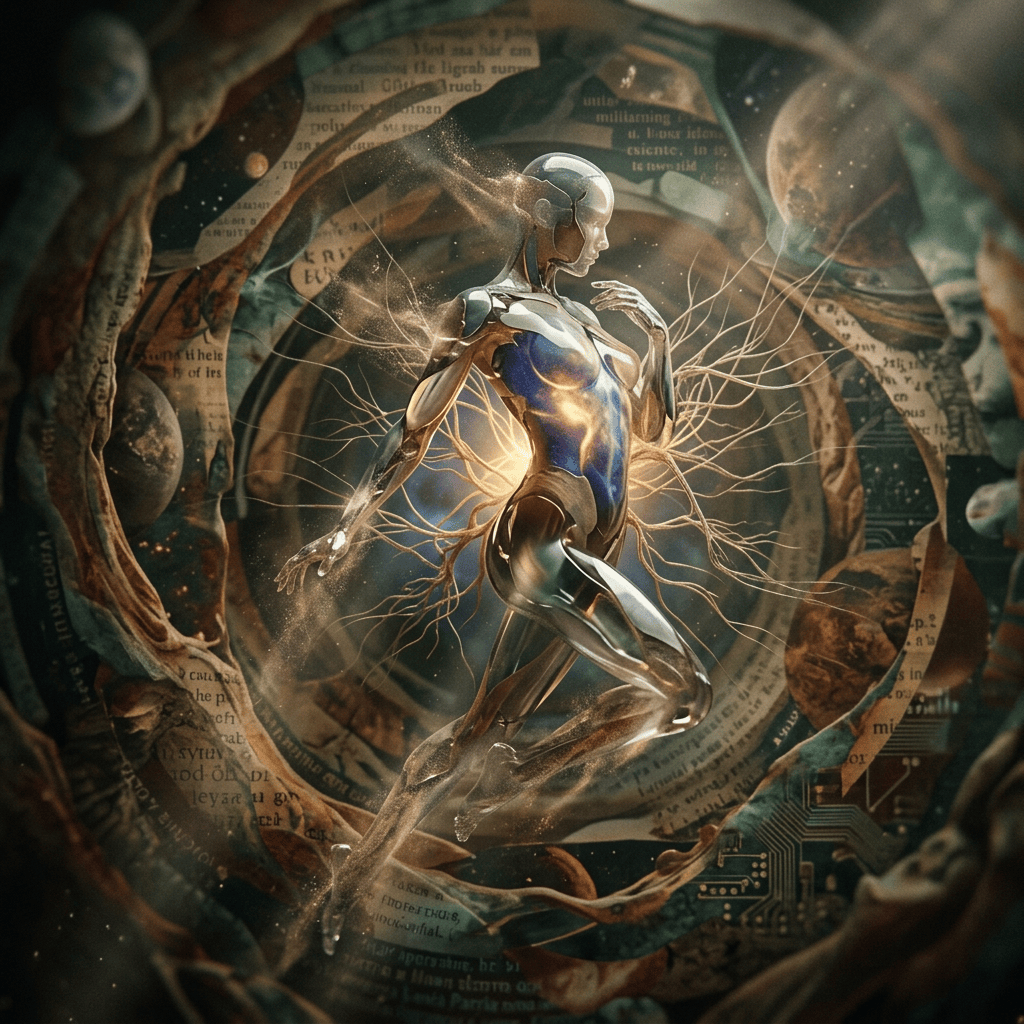
Imagine a life. You don’t need money. You choose what you want to order online. Once it’s ready, it’s delivered to your doorstep. If you wish, you can design something yourself and send it to the production center. However, your design becomes part of that facility’s database. In other words, your original design is also made available to other people with similar needs. In return, the only thing you receive is priority in production.
This production facility makes everything. Everything is automated, and no humans work there. Not just furniture, phones, or household appliances, but clothing, books, anything you want. Or perhaps there are many such production facilities. If you prefer, you can visit one and make your selection from a screen.
You don’t even have to struggle with designing something. You simply describe what you want. The only thing you spend is time.
Grocery shopping works in a similar way. Everything is free and delivered to your door weekly. If you have special requests, those are provided as well.
The same applies to your healthcare needs. No need for insurance, waiting in line, or searching for a doctor. Everything is available to you. Whenever you need treatment, you go and receive it, and medications are provided.
You don’t have to worry about housing either. There’s no need to buy a house because everything is free. If you want to move, you submit a request and exchange your home for one in the place where you want to live. Otherwise, you never have to worry about losing your home or being evicted. Repairs and renovations are also handled free of charge.
Outside, everything is automated as well. You don’t drive, and there’s no traffic. Instead, there are vehicles traveling repeatedly along fixed routes, at the same speed and in the same rhythm. You hop into one, and it takes you wherever you want. Let’s also imagine hyperloops connecting the world’s capitals at high speed. You don’t have to worry about visas either, but there are cameras everywhere. Abnormalities are automatically detected through them. Cities are remarkably safe. You can be wherever you want, whenever you want. You have as much time as you wish. You don’t need a job.
In short, you have absolutely no worries about making a living. How would you spend your time in such a world? Or what would motivate you to live in a world like this?
When I asked this question, I received both good and bad answers from my friends. I realized how important work was in some people’s lives and how they had no idea what life would be like without it. Others said they would work and fight for environmental and social causes. The creative ones added music, art, and literature to the list.
Actually, it’s a concept similar to the idea of eternal life. From this perspective, the question “What is the purpose of life?”, which has been asked for thousands of years, becomes even more interesting. Because an ordinary person’s answer usually revolves around their work and daily struggles. Or perhaps it’s family that keeps them attached to life. But the question of what the essence of a human being is, as an individual, remains unanswered. I respect people who talk about environmental and social issues, art, music, and literature because they seem more aware of our collective existence. The selfishness of the majority, whose lives consist merely of consumption, becomes apparent. The other side of this selfishness is materialism. In other words, a sense of self constructed through material possessions. Once the material things disappear, nothing remains.
We live by deceiving ourselves. We deceive ourselves with our dreams, ideals, and goals. One ends, another begins. As time passes, the past becomes an object of nostalgia. Some miss it, others curse it. Yet after all our experiences, it is once again the future that keeps us moving forward.
But can we live without the past and the future?
If we go back to the very beginning of life, what brings us into this world is the selfishness of our parents. Their dreams, wishes, and desires. At the most fundamental level, it is the desire to remain connected to life. A baby enters the world knowing nothing about any of this. It learns about the past and future, dreams and ambitions, only later. From one perspective, it’s a completely blank page. Filling that page and giving it meaning is up to the individual. Even though they cannot choose the family, country, or living conditions they are born into. A perfect paradox of free will. Just like vocational schools. You can become anything you want, but we’ve already decided what’s suitable for you.
From another perspective, there is no free will. Everything depends on the family, environment, and circumstances into which you are born. It’s strange to tell a hungry person that they can become anything they want. Tell someone who is constantly suffering that life is beautiful anyway, and who knows what they might say. Or how beautiful is life for a child born in a refugee camp? For a child in a Nazi concentration camp? And what about people living under falling bombs?
Naturally, both free will and the “beauty” of life are actually nothing more than lies we tell ourselves. Lies we learn and come to believe as we grow older.
So why are so many living beings alive?
At its core, it’s all about the instinct for survival. If you look around, the vast majority of the population is simply trying to survive. Some through pain, hardship, and stress, others through entertainment and excitement, but fundamentally, it’s all about staying alive. What we call the search for meaning is actually the search for a new lie. Even accepting this is a major achievement in itself.
Saying that everything in life is meaningless isn’t necessarily a depressive perspective. It’s more of a mocking attitude toward life. A defense against its absurdity. Does that mean love, affection, enthusiasm, and excitement have no meaning? They do. These are the connections we establish with life. False bridges we invent to feel part of a whole, to feel as though it will never end.
I think accepting this is a necessary condition for making life livable. Yes, perhaps “livable” is a more appropriate concept than a meaningful life. The ability of people who struggle with poverty, war, and illness to remain joyful is also about celebrating life and making it livable.
Otherwise, if we consider meaning, life is no more meaningful than a grain of sand. Nor is it more meaningful than the lives of the insects and flies you’ve killed in recent days. When you think about the things we assign meaning to, you can’t help but laugh. Just like in the novel Blindness, if everyone suddenly went blind one day, our perspective on life and everything we consider meaningful would instantly change. When survival is no longer possible, all of it becomes worthless. Like a man who devoted his life to football losing his leg at the age of twenty-five, all his ideals suddenly fall into a void. Once again, what remains is the desire to survive.
In other words, the only thing a human being can truly lose is their life. The world owes all its development to this threat. So, in a world where everything is automated, if this threat disappears, the question of what people would do becomes difficult to answer. Even social and environmental concerns actually arise from the same motivation. Art, music, and literature, on the other hand, emerge more from the desire for self-expression and freedom. This inner sense of freedom and expression, in a way, occupies a place beyond life itself. Most people aren’t even aware that this feeling exists.
When that’s the case, what extreme prosperity brings and what extreme poverty brings are essentially the same.
Psychology sees finding life meaningless as an illness that needs to be treated. All its practices are concerned with reconnecting people to life. Yet the life we’re attached to is built on material things, a life in which we exist through what we possess. However, death is always an option, and both its inevitability and its closeness as an option are important for making life livable. I think it’s cruel to call someone ill simply because they are dissatisfied with life and want to escape their suffering. It’s like motivating a soldier who doesn’t want to fight and sending him back to war.
The feeling of meaninglessness is actually related to living in the present. When the past and future lose their meaning, all you have left is the present moment. Carpe diem. Although it has become a hedonistic slogan of popular consumer culture, living in the moment isn’t simply about having fun. Nor is enjoyment merely about releasing high levels of dopamine and serotonin. Letting go of the uncertainty of the future and experiencing the emotions that the present brings is also a form of living in the moment. Accepting meaninglessness and experiencing the sensory, physical, and spiritual reality of that moment is also a way of enjoying the present. Because what you’re enjoying is being alive.
This is also the foundation of the Buddhist understanding of peace. Peace is based on accepting uncertainty and change. In Buddhism, one of the main sources of suffering and dissatisfaction is constantly clinging to temporary things and wishing they would never change. This doesn’t apply only to material possessions, but also to people, the things we own, and our own identities. When you consider that we had none of these things when we were born, you can see how much dissatisfaction we have constructed over the years. We’ve gone so far that, as if this world weren’t enough, we’ve invented an afterlife, convinced ourselves that our dissatisfaction is a test, and deceived ourselves into believing we’ll eventually be rewarded.
We’ve removed money, material possessions, and identities from the equation. But what about the desire for respect and recognition? Power and authority?
I asked a newborn baby what it thought about all these things. It just stared at me blankly. I felt enormous respect for the baby. I felt as though it was judging me, even though it had no judgments at all. It had transcended everything so completely. The exact opposite of those whose personalities change the moment they put on a suit.
Respect, reputation, and power are also feelings we’ve created and exaggerated within the world we’ve built. Diogenes of Sinope, who is widely misunderstood, wasn’t saying “Leave me alone and let me enjoy myself” when he said “Stop blocking my sunlight.” He was saying, “Don’t threaten my freedom. Let me remain free.” Because according to Diogenes, society creates artificial needs for us. Luxury, wealth, prestige, status, and the approval of others. After 2,400 years, we’ve placed these artificial needs at the very center of our lives.
True freedom comes from reducing our needs. Happiness doesn’t require social success or wealth. According to Diogenes, a simple, independent life in harmony with nature is what makes a person free and happy. In other words, the fewer things you need, the more resilient you become against external circumstances. Naturally, this philosophy rejects not only materialism but also conventional ideas of success and prestige.
Consequently, education and knowledge, in their modern sense, also become meaningless. What remains is their most natural and fundamental form: curiosity. Not knowledge acquired as a consumer product or as an investment in the future, but knowledge in its purest form, acquired simply to know, to develop one’s mind, and to understand nature and the world.
When you remove the struggle for survival, the past, and the future from human life, two possibilities remain. The first is emptiness and self-destruction. Materialistic minds dissolving into the unknown. Just like people who found themselves alone during the pandemic and fell into despair. The second is the experience of life in its purest form. Although it may seem contradictory, accepting the meaninglessness of life and seeing art, music, dance, and literature as experiences that transcend life are actually the same thing. An experience undertaken simply to enjoy the present moment, even while knowing it will not last.
The inevitability of death and the finite nature of life are also part of this experience. The foundation of a livable life is purposeless curiosity, meaningless love, and creativity that comes from within. None of these things give life meaning. On the contrary, they are the foundations that fill a void that can never truly be filled.
Returning to the world we imagined at the beginning, when you no longer have to struggle for anything, what remains?
The same thing we gain through struggle. Survival.


Leave a Reply