A Turk won an election in Berlin. Sorry, a Kurd. No, actually, a German.
Apparently her father was a committed leftist, looked at the world from below and moved left. No, was moved. Actually, if you keep going right or left long enough, you end up in the same place anyway. In space, there is no right or left, up or down either, by the way. Good luck getting out of that one.
Jokes aside, the chances of this person being elected in Turkey are lower than the chances of Erdoğan calling me before the next election and saying, come on, you be president. And not just on April 23*, for the whole next term. Or the chances of someone with the same profile becoming president… She would not even become class president. They would say everything imaginable about her.
We are people who flinch when we see a foreign surname. We also tell people, if you do not speak your mother tongue, then you are a good person. And when it comes to the people whose bloodlines we massacred or drove away, we brush it off by saying, ah well, those were the conditions of the time, you should not have rebelled either. Think about how impossible it is.
There are also prisons, where the correlation between education level and opposition happens to be suspiciously high. If that does not work, there are dozens of other things that increase the impossibility coefficient: drugs, prostitution, gambling, ‘I did not like your joke’*. If that does not work, a trustee. If that does not work, sexual orientation. If that does not work either, religion.
The Germans are not at that point yet. They are still at the “the country is slipping away from us” stage. Both the winner and the loser look at the other side and say the country is slipping away. Some people have also figured out the big picture. Look, Germany is being divided again, and so on.
I am also a big-picture person. Ever since I came to Germany, I have felt that the Berlin Wall never really came down in people’s heads. When I go west, there are people asking me, “How do you even live there?” Then there are people who went west, felt excluded, and came back east. I even have a friend who has never visited me because he says, “I would never go there.” I find this very interesting. Luckily, they managed it. Election maps now look like maps of divided Germany. Just like our maps.
Again, just like in our country, some people complain about not reaching ordinary people. Apparently, instead of wasting time with environmental issues and such, they should have listened to the public. They should have listened a little more and accepted that there is a refugee problem. I listen to the public. It is not somewhere you want to go down into. Trust me.
Brother, people do not like imitations. If they liked imitations, they would not get angry at the people calling them sheep. The whole thing is emotional. I do not like social democrats either. Because they are neither social nor democratic. Apparently, if they had bent a little, it would have worked. They keep bending until they cannot straighten their backs anymore and split into a thousand pieces, but they will keep bending anyway. Then there are those sentences beginning with, “I’m not, but…”
Are centrist policies the same everywhere in the world? Let us eat, drink. Let us get uncomfortable when we see a little diversity. And when someone criticizes the rich, let us join the chorus saying, these people are communists, they are after our property. Then afterwards, oh dear, why did things turn out like this?
Being social ends when the money runs out; being democratic ends when freedom runs out.
I am talking about Germany, just to be clear.
The democracy paradox. If you ask the people, democracy disappears. If you do not ask the people, then it cannot be called democracy. The best thing is to ask lots of questions and confuse everyone. Increase the number of institutions and slow the system down.
Frankly, I find racists more sincere. At least it is clear what they want. Sorry, what they do not want. Although they also spit hatred at democracy and then suddenly become democrats the moment someone mentions banning them. When they are called racist, they say not all immigrants, only illegals. When you mention the economy and such, they say long live the rich, let the poor die, and when you tell them, you are poor too, they say do not dig into it too much, fuck it, and continue with their lives. I wonder if one day they will make me wear a “legal immigrant” armband.
Who is left? Those who oppose capitalism using Apple and Amazon, and those who take a slightly more natural approach to the whole thing and imagine a beautiful world built around people and the environment. Apparently they are not sincere either, and not realistic. Look at that.
I say all this, but I have genuinely seen many people resisting the system too. I would be lying if I said I did not feel ashamed when I saw them. When I think about it for a while, like Nietzsche, I start thinking, to hell with the work you are doing and the system you have built, and I feel like packing my bags and leaving. But not for the Alps, and not for Nepal either. To the highlands. If there is any land left that has not been sold.
The Big Picture
When I think about it, my entire idea of the Germans seems to have consisted of: we lost the First World War because of them, let us not talk about the Second World War, unnecessary coldness during the Soviet period, techno parties after the fall of the Wall, Merkel emerging from behind the Wall, a crowd angry with her, and the incompetent people who came after.
And also, the tax and insurance system. Despite two world wars, the fact that people’s insurance policies were paid has always surprised me. Who they paid them to matters too, of course.
Anyway, once things were like this, I started reading a little. And actually, my primitive brain, which tends to compare everything with everything else, came across an interesting picture. The East-West Germany map is not just something from the years of the Wall. Apparently, it has existed throughout history.
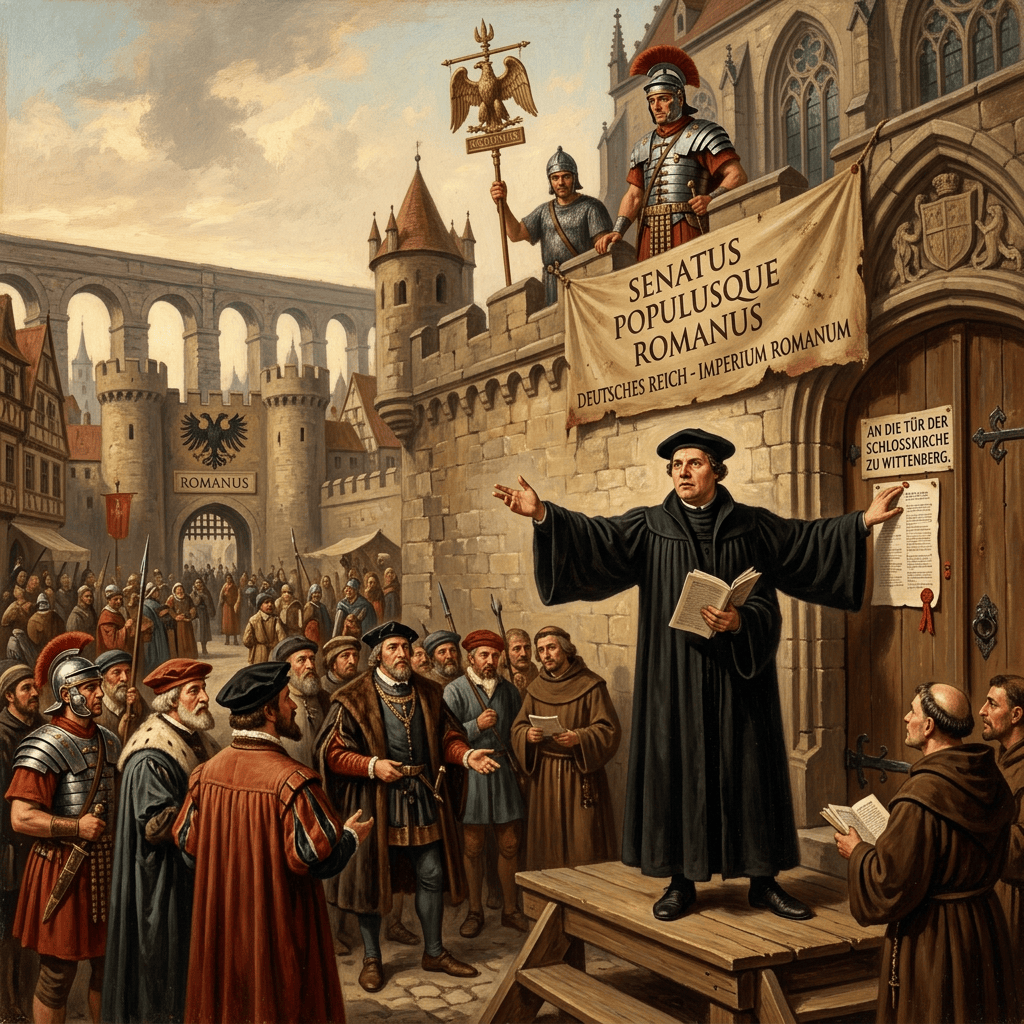
They say Caesar was the first person to call Germany Germany. Back then, there were Romans and barbarians. Just like later there were Europe and barbarians, Europe plus Russia and barbarians, the West and barbarians, Earthlings and aliens.
At some point, while Caesar is eating grapes and drinking his wine, he hears shouting and chaos. Migration has begun from the northern border. People are pouring into Rome. There is no UN, no European Court of Human Rights, and nobody is saying shoot whoever crosses the border, Rome belongs to the Romans. He gets curious and asks what is going on. They tell him that the barbarians in the north are slaughtering people.
Caesar says, “Who are these insolent barbarians?” He immediately prepares his army and heads north. Of course, crossing the Alps is not exactly easy. So he goes around them. He reaches the Rhine. Between those who submit and those who join him, he stops there. The rest are barbarians, he says, I do not want them. He cannot really advance anyway. Is crossing the river easy?
In later centuries, Christianity also appears and becomes our problem. Constantine opens the way, some people convert here and there, and Rome slowly begins to weaken. The Franks enter the stage, and of course the Germanic kingdoms too. The Franks are very close to the Roman Catholic Church. They live their golden age under Charlemagne. Today’s France, Benelux, northern Italy and a large part of Germany are in it. Again, the border is drawn roughly along the Rhine. Somewhere along the way, he also says, these barbarians make good soldiers. The kingdom has a west and an east too. Even the region known today as Franconia gets its name from there.
Just when you start wondering where the Germans are, the Papacy comes up with the brilliant idea that the empire should be revived and declares Charlemagne emperor. Christianity destroys the empire for the second time, and with Otto I, the Germans enter the stage. The political structure we call the Holy Roman Empire appears with the idea that you are all Germans and we are Rome. You know the rest. Mehmed the Conqueror arrives later, says I am the last Roman Emperor, and causes more confusion.
During the 550 years that pass, there are questions like, are we Romans or not, why does the Church interfere in everything, are we French or German, if we are German then why are we reading the Bible in Latin, are we Crusaders or what? Then one brave man appears. First he says we need to translate the Bible into German so that we can understand the religion we believe in. Then he reads it and says, this is not real Christianity, and causes chaos. Boom, another East-West Germany crisis.
German lands split into Catholics and Protestants. Caesar’s barbarians now appear in the same region as Protestants. Then with the Peace of Augsburg, they say everyone should believe in the religion of their own region and stop making a fuss, but the conflict does not end. The famous Thirty Years’ War divides the geography into hundreds of units. Anyone who breaks free starts walking around calling himself a lord.
Meanwhile, Napoleon rises in power. He says the Holy Roman Empire is back and makes one of the most repeated mistakes in history. He says, I will take Russia. But he loses at Leipzig. He returns to France. Finally, the British, Germans, Prussians and Dutch unite and finish off both Napoleon and the Holy Roman Empire.
Of course, within all this history, farther east there are also threats such as the Huns, Russians, Hungarians and the Polish-Lithuanian Commonwealth. These threats are sometimes the reason behind strong unions.
Anyway, afterwards, the wave that comes with the French Revolution turns into the German Empire under Prussian leadership with Bismarck. Wilhelm I also gets involved. Nationalism is popular at the time. While imperialists and monarchists are considered backward, nationalists are considered modern, progressive and educated. Riding that wave, Germany grows and unites. I do not know exactly where we join the story or why, but the image in our heads of the systematic German, the perfectionist German, comes from Prussia and this period that follows. The rest is, as you know. They lose the war, we receive the news and say okay, apparently we lost too. Then comes fragmentation, division, harsh sanctions. Then reunification. Then division again, and reunification again, and today.
So Germany’s division into East and West may actually be an issue going back thousands of years.
Apart from all this, Berlin has somehow always managed to remain different within this division. That too has been the same for thousands of years. Germany is divided east and west, and every time Berlin itself is divided in another way. Throughout history, it has repeatedly become a symbol of change and freedom. Same again.
While thinking about how far we came from where we started, there are one or two other details I found interesting. One of them is that killing your brother for the throne was not normal. There is even someone who at some point says, I cannot deal with this anymore, I am going to Rome, then goes off to run the Roman Empire and leaves the Germans behind to his cousin. That period even goes quite successfully.
There is Otto I, who intends to kill his brother because his brother rebelled. Even after being the target of an assassination attempt, he cannot bring himself to kill his brother and forgives him. He even gives him a duchy. When I read this, what surprised me most was myself. I already knew they did not have our tradition of “eliminate the brothers,” but I kept wondering why I had accepted killing brothers for the throne as if it were something normal that should happen.
I was surprised that I was surprised that a king did not kill his brother or his children.
Another interesting part is kings who came to power through elections or left power through elections. Again, I was surprised to learn that Otto I came through election, then I learned that Scandinavia, Hungary, Poland-Lithuania and Bohemia all had elective systems too. I only partly knew about Rome. In that case, burying all your rivals might not even help much. On one side, England is partly based on eliminating rivals, and on the other, the Ottoman Empire is completely built around taking down rivals, so it is strange that the region in between was not influenced by this. Then again, apparently we were not influenced much by Rome or Ancient Greece either. Even pagan Germans probably did not take the word “barbarian” as personally as we do.
So in the end, this is the big picture. Democracy is apparently a matter of tradition and custom. This is as much as we managed with the hundred years we spent learning it. It now feels more normal to me that people do not understand racism, democracy or freedom in Europe. It is also not surprising that lands that have been split in two for thousands of years keep falling into the same dilemma again and again. It really does seem to come down to cultural differences.
Not being able to get past these things, however, is a disgrace to humanity. If artificial intelligence starts making jokes one day, it is going to make serious fun of us. Do not say I did not warn you.
*Aprıl 23 is the children’s day in Turkey. To show the importance of children for the future of the country, politicians and other seat-valued people change their place with a child for a day.
*On 3rd July 2026, a young comedian Deniz Göktaş was sent to prison because of his ‘offensive’ jokes in his show.
*Similarly, many politicians, journalists, artists, social media rebels, influencers, students are at prison, including modern cam girls.


Leave a comment