
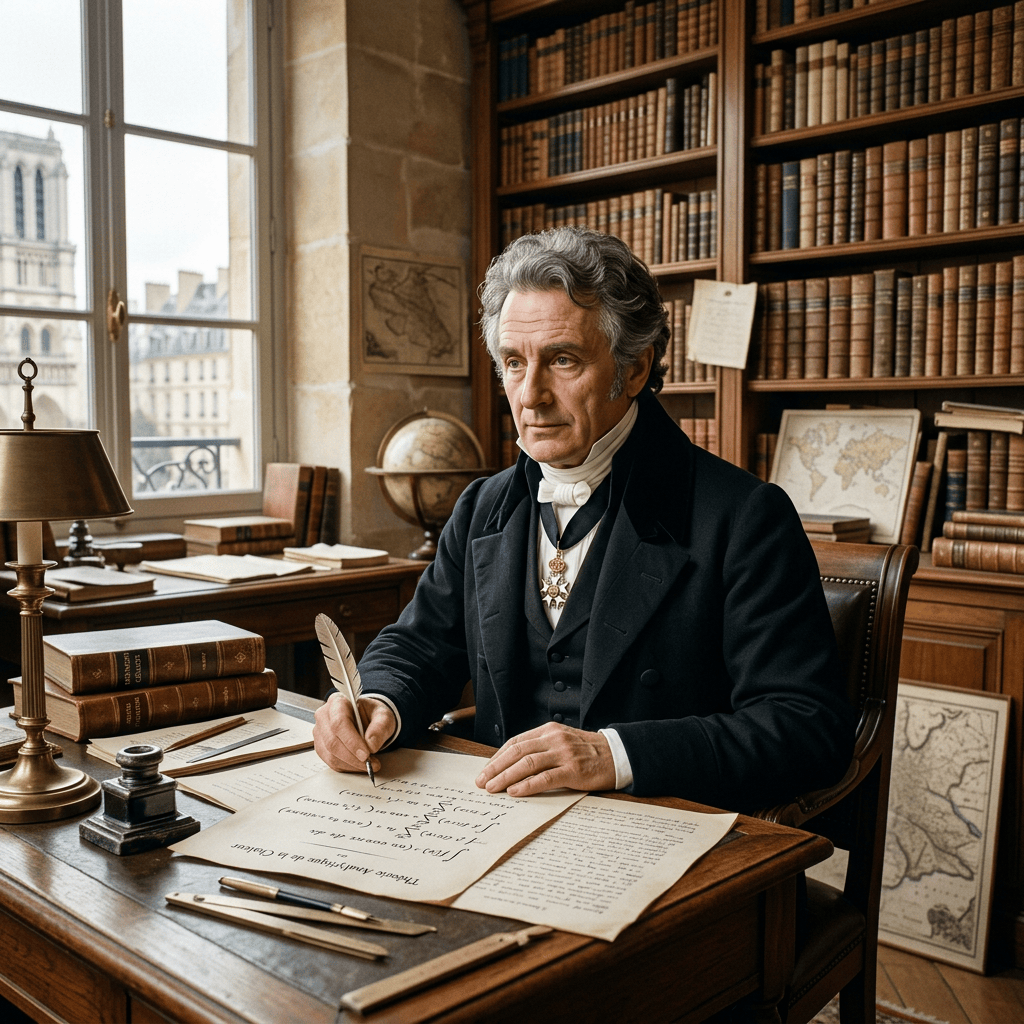
The year is 1768.
He is born into a poor family. He loses his mother at the age of nine, and his father a year later. By the age of ten, this child is an orphan. That child…
He devotes his life to education. He has a strong relationship with mathematics. At the age of fourteen, he studies Étienne Bézout’s six-volume mathematics work. At fifteen, he receives an award at his school for his work on mechanics. I know, I was there.
Later, in 1787, he joins a Benedictine monastery and begins training for the priesthood, saying, “Peace is in Jesus.” But apparently he does not find much peace, because he continues studying mathematics as well.
At the age of twenty-one:
> “Newton and Pascal had already achieved immortality at my age.”
he writes in a letter. Of course, back then there were no life coaches saying, “Do not compare yourself with others, you are all special.”
Then, just as he is about to say, “To hell with the monastery and my vows,” and go his own way, guess what happens?
The French Revolution.
Our hero, thinking, “Well, I did not become Newton or Pascal,” decides, like every tense idealist, to become a revolutionary and joins the local revolutionary committee. But the Revolution, as revolutions often do, turns into the Reign of Terror. The priest inside him objects to this, and while he tries to distance himself from the movement, saying, “To hell with these people too,” the state makes its move before our hero can, and arrests him. The year is 1794.
While in prison, he thinks that, like many revolutionaries after him, he is going to end up at the guillotine, but through the eye of a needle of coincidence, Robespierre falls and is sent to the guillotine. Our hero Joseph, meanwhile, is released. A kind of general amnesty. Later, because of his past, he is arrested and released again, and continues with his life.
At one point, he goes to Paris. He joins the circle around the École Polytechnique. The people he meets there include Laplace, Lagrange and Monge.
In fact, in 1797, he is appointed to the chair of analysis and mechanics after Lagrange. Just when his academic career has settled into place and everything is running smoothly, Napoleon says, “We are going to Egypt,” and he joins the Egyptian expedition, which also includes scientists. There, he takes part in archaeological research, helps establish educational institutions, and becomes secretary of the institute in Cairo.
When he returns to France, he even meets Jean-François Champollion in Grenoble. He shows him a copy of the inscriptions on the Rosetta Stone. Champollion is still a child at the time. He becomes interested in these inscriptions. As time passes, he eventually plays an important role in deciphering Egyptian hieroglyphs, but that is not our subject.
Joseph, by now thinking, “Please just leave me alone so I can go back to academic life. What am I doing with history? I want mathematics,” is made a governor by Napoleon. Although he does not particularly like it, he accepts the position. The man who compared himself with Newton and Pascal is now draining swamps, organizing public order and carrying out road works.
At night, he searches for answers to strange questions such as: if I heat one end of a metal rod, what happens? If I know the geometry of an object, can I calculate the temperature at any point on it?
After thinking a little more, he says: can I reduce complicated things to simple waves, for example? What is this complexity?
For example, could a complex sound signal be the sum of simple waves?
Wave after wave after wave, frequency after frequency, Fourier series and Fourier analysis begin to emerge. Of course, the academic world, as always, reacts with the equivalent of, “Dude, just go away.”
Is it easy to convince Lagrange and Laplace?
So he enters the competition organized by the French Academy on heat problems and wins the prize. But the committee still gives him a hard time. They say, “There must be something suspicious here,” but eventually his work gains acceptance.
Today, if we can obtain images with MRI machines, connect to Wi-Fi, take photographs with our phones, or listen to digital music, the mathematical equations developed by Fourier lie at the foundation of all of them.
And not only that. He becomes so obsessed with heat that, in 1824, he also points to an important problem: if the Earth receives energy from the Sun and constantly radiates energy into space, why is it warmer than expected? Years later, the answer to the question arrives. The greenhouse effect. Today, when I see people saying, “I do not believe in climate change,” I get annoyed.


Leave a comment