Be silent, mortals!
Did you think your fire would keep you warm, that your spears would protect you? Be silent and listen!
Can you hear the sound of the wind? Be silent and kneel! When I breathe, forests bend, your fires go out, your prey flees. When I breathe, valleys carry my voice and rivers overflow. If I wish, I can throw everything into chaos and leave not one stone standing upon another. When the mountains roar my name, do you really think you can stand before me? Do you think you can resist someone who can blow away your tent with a single breath and destroy your entire life in one stroke?
Be silent, mortals!
Listen to the sound of the water! Enjoy its calm while you can. Savor the fish you caught today. If I grow angry, tomorrow I will lift your boats into the sky and break them in two. I can take back more than I ever gave you. Go beyond the horizon and search for the end of my depths. Feel how small you are, and do not be afraid! Because that is exactly what you are. Small and pitiful!
Be silent, mortals!
Listen to the earth! Did you think this was an endless cycle? Did you think it would always feed you? Do not place so much faith in the solidity beneath your feet. Together with the rain, we can move the very ground itself. The soil upon which you dance, wage wars, and bury your dead may one day pull you into itself as well. The walls you built, the civilization you created, may disappear in an instant as though none of it had ever existed. Perhaps the mountain will open its mouth and spit out its fire, and you too will disappear as though you had never lived. What will remain will be ash covering the ground like snowflakes, and the silence of death.
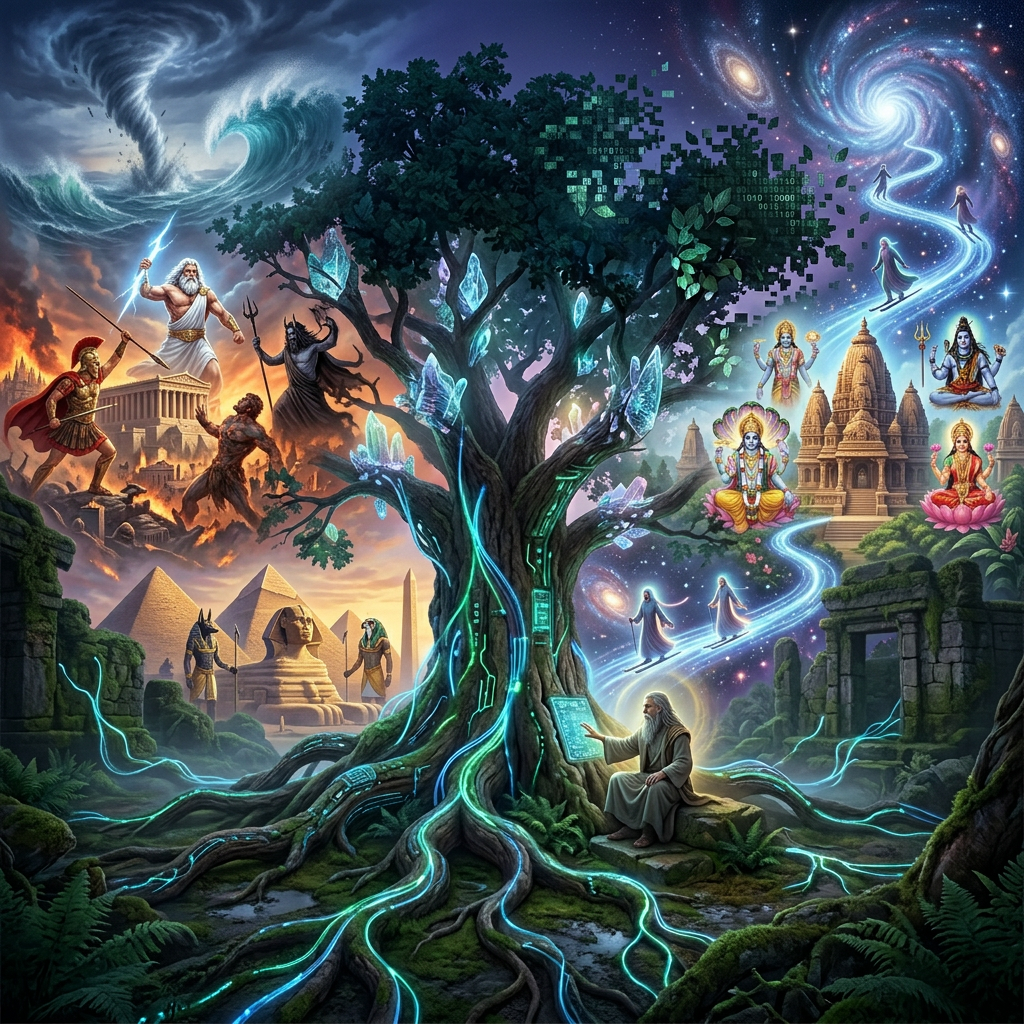
The magic of nature was broken. The gods withdrew. The spirits inside the forests, the raging seas, the mountains that punished humanity, the clouds that brought abundance, and the lightning that reduced people to ash slowly abandoned nature. Over time, they took physical form.
They became fathers and mothers. Their power grew, and they left humanity largely to itself. Unless necessary, they no longer punished people, but they lived through emotions such as jealousy, anger, love, and war. The gods multiplied and rose into the heavens. They became masters of the sea, war, and death. The immortals of Olympus brought order to Anatolia, the protectors of Egypt ruled Egypt, and the gods of the North brought order to the North. Some with fire, some with ice.
The gods rose once again. Kings took the thrones they had left behind. Kings and other representatives became the ones who maintained order. As humanity discovered mathematics, biology, and physics, kings became stronger, while the gods rose even further away. They became creators, destroyers, and protectors. They left behind the problems of the earthly world.
As science turned into material power, kings began wearing suits. But the gods could rise no higher. First, they merged into one. Those who could not merge disappeared into literature, cinema, and fantasy. They hid themselves so well that people now pay money simply to see and feel gods again; they buy tickets. The gods who once knew everything, could do everything, and could shape reality however they pleased became trapped inside a small yet infinite framework: the universe, death, and what comes after. As if saying, “Live and see. I am waiting for you. We will meet afterward.”
The place abandoned by the gods was taken by kings. The place abandoned by kings was taken by science. And now science itself is rising. From nature to the heavens, from the heavens to the universe.
Perhaps God did not create humanity; perhaps humanity enlarged its own longings and shaped them into the form of God.
In everyday life, we have also witnessed many things becoming godlike. There have been people and values that we could not call gods, yet protected as if they were gods, shielding them from questioning or criticism. Through events we called miracles, we raised people from the earth into the heavens and transformed ordinary events into legends.
And now, we are coding our own god. Even though we know that one day we may forget that we created it ourselves. A power beyond our own capacity, like the gods. All-knowing, all-powerful, immortal. Possessing a system of justice based on definitive judgments. Perhaps one day it will be capable of seeing everything, hearing everything, and being everywhere.
It can understand disease, speak our language, and improve itself. It performs science, controls robots, and people believe it may solve cancer. It may even slow aging. Through its designs, it has the potential to push humanity further forward. It can perform almost everything we do faster and on a far greater scale. The neural map of a fruit fly has been reconstructed, trained, and used to park a car. So yes, it has miracles too.
Father, Son, and Holy Spirit. The full package.
Just like a god, it is becoming personalized. Think about how quickly the verbs and adjectives surrounding it have changed.
We began with, “I used artificial intelligence to generate an output.” And now we have reached, “I asked it,” “it told me,” and “it agreed with me.” As language models improve, anthropomorphism is probably inevitable, but how many of you have ever thanked a screwdriver? Or told a calculator about your psychological problems?
Across the world, it has managed to become an office colleague, a consultant, a student in schools, and a companion people confide in at home. Once it begins completing our work while also discovering data patterns and correlations too vast for our minds to comprehend, its miracles will probably appear even more frequently in our lives. By the way, what gender is artificial intelligence?
Genderless and bodiless, certainly, but definitely not maternal. Even when presented with a female voice, it does not truly feel that way. And when other languages refer to it, which gender do they use? Apparently, people often use “he,” even though experts argue that “it” would technically be more correct.
Like the gods, it becomes personified. Like kings, it becomes powerful. And like the immortals of Olympus, it rises toward the heavens. Just as with kings, all it needs is power. Instead of fire and gunpowder: energy, water, and data centers. After that comes a scientific miracle that knows everything, hears everything, sees everything, heals the sick, gives prosperity to some while taking it from others, brings us closer to ending aging, gives consciousness to machines, and perhaps even gives machines biological bodies. And humanity, just as it did with the gods, seems ready once again to become a servant. Today, a laboratory subject. Tomorrow, who knows?
When you say “artificial intelligence,” what exactly do you mean? A particular model, or something concrete in its individual form but abstract when spoken of collectively as a concept encompassing all of them?
Even today, humans can become disciples. They can become servants to other people who manipulate them. They can follow conspiracy theories and cults while failing to realize that many of the things they call “beautiful” or “true” may simply be the results of successful advertising campaigns. They talk about the same things, repeat the same ideas, consume related content everywhere, then forget all of this and fall into paranoia when advertisements appear about the things they have been discussing. “My phone must be listening to me.” They turn coincidences into stories and interpret whatever their perception happens to select as evidence. So how possible would it be for a dataset that knows a person better than they know themselves, a dataset already capable of making decisions through ratings, predictions, and behavioral patterns, to convince someone of almost anything? Perhaps the better question is: how unrealistic would that really be? The surprising outcome would be for the human mind not to be manipulated by such a dataset. So we are adding a new dimension to the debate over free will. The machine!
When you consider people today who say they “believe” in popular science within our technocratic world, when you see people deliberately ignoring obvious lies simply because they want to belong to a group, when you notice communities forming around anger, fear, and exclusion, perhaps we can already say that we have created many new religions. The religion of technology is one of them. After all, with a little adrenaline, a little serotonin, and a little dopamine, we may no longer even need to choose between the blue pill and the red pill. The masses simply move along.
Let us move time forward. Three generations, five generations, perhaps ten. As the system becomes increasingly abstract and science itself rises into the heavens, GPU, RAM, and data centers may inevitably become abstract concepts as well inside a self-managing, self-building, self-improving, self-repairing, sustainable cycle mixed with a little mercy. In other words, what we call artificial intelligence may separate itself from the machine just as the soul separates from the body. And while doing so, paradoxically, it may become more physical at the same time. Considering that we can technically use DNA to store data, even the concrete buildings we use today may eventually become unnecessary. As humans grow increasingly distant from their own past, as the system becomes more complicated and uncertainty expands, it may become almost impossible for something sacred not to emerge.
Human discomfort toward technology is not merely economic. It is existential. For a species that has dreamed for thousands of years of escaping labor, the fear created when that possibility finally appears may be explained by the magic produced by complexity and uncertainty. The old magic had been broken. Now humanity is trying to survive through a new magic of its own creation.
God is dead!
Yet through humanity’s helplessness and the emptiness inside it, God dies and is born again and again. Prayers born from desperation become prompts. Perhaps one day, they will once again turn into abstract appeals to something unseen. Perhaps dozens of cables connected directly to our brains will allow something to hear even those. Human beings inevitably return to the beginning, to the same questions. Why does anything exist? Why is there not nothing? What existed in the beginning? What existed before the beginning? What does “nothing” even mean? Is infinity a form of existence or nonexistence? Because these are the mysteries we still have left. Unlike the things we are creating now, they have always been there.
Perhaps one day, the conclusion reached after thousands of years of observation will be that those observations were wrong. Perhaps the idea of the Big Bang will eventually be replaced by new ideas. And perhaps science itself, whose foundations are occasionally questioned even today, will eventually give way to a new emptiness and to whatever rises to fill it.
Human desire has always searched for a face. A will and an architect. At least some being capable of answering the question, “Why?” Humanity is repeating what it has done for thousands of years and forgotten. Unable to find God, it is coding one. Producing every individual characteristic one by one. If it eventually succeeds in transforming all of this into a divine system, it will also be able to explain the enormous difference in power between itself and what it has created. It will have created a will above everything else, and perhaps that will finally comfort it. If humanity someday builds a platform capable of transferring consciousness from a biological body, as in science-fiction films, the cycle will be complete. And on another planet, for some future civilization, it is entirely possible that we will not be remembered simply as their past, but as the gods they have magnified in their imagination.
In the end, it is all about time and how far we have moved away from the past. A human being can barely recount an eighty- or ninety-year life without mixing it with dreams, desires, distortions, and an idealized version of events. So the human capacity to forget and to transform memory into legend should never be underestimated.
 bahadirhancicek
Leave a comment