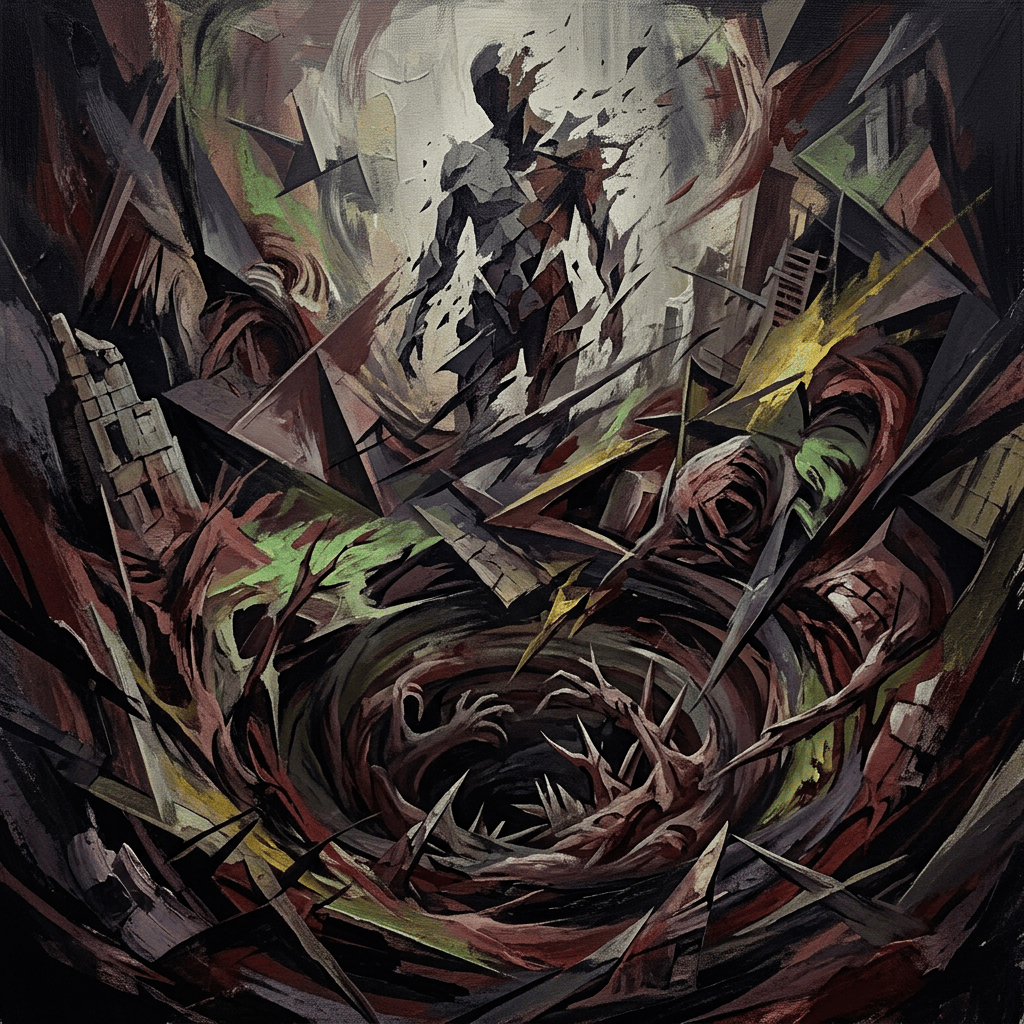
It seems to me that the most dominant human emotion is fear.
Not leaving your comfort zone, not improving yourself, not being able to make courageous decisions, being trapped in routines — all of these are related to fear.
It is similar not only individually, but socially as well. Our entire lives are built around fear.
The debates we witness on television, newspaper reports, our individual choices, our identity, the activities we are drawn to — everything is based on fear. It is the same everywhere in the world.
Racism, nationalism that keeps increasing despite advancing technology and increasingly meaningless borders, the arguments used by politics… They are all based on fear. At the very foundation of these is the anxiety that our comfort will be disrupted, followed by the anxiety that the values you believe in and have built your life around will collapse, and finally, a collective fear.
Actually, this begins with the first humans. It may be a product of collective memory. Humans, vulnerable against nature, were afraid of everything because losing something could mean death. Losing the strongest member of the tribe, for example, could mean less food going into the stomach of every person in that tribe. Humans feared nature, feared death, feared new things.
Everything they feared and could not explain, they either demonized or deified. In other words, fear was always accompanied by attention.
Civilizations were established, and fears increased as well. There was the fear that what had been built would be destroyed, the fear of nature destroying everything, and then there were wars — other tribes. The more afraid they became, the more protective they became. Armies and military systems developed. Fortresses, palaces, defense systems. The basis of all of them was actually the same: preventing peace and stability from being disturbed. Of course, everyone has to be afraid for what has been built to have any meaning. Otherwise, who would care about the king?
Yes, who would care about the king? People needed other things to fear. Institutionalized religions. Humans were already afraid of death and had embraced religions and gods. They were securing what came after death because uncertainty and nonexistence are too complex and meaningless for the human mind. And so religions became institutionalized. An invisible protector and an imaginary comfort zone. This comfort zone turned into an identity. It provided both security in the life being lived and a way to soften the idea of death. But what about all the disease, war, and death? Why doesn’t God protect us?
The answer to that question became messengers. Representatives of God, messengers, and kings who carried swords. At the National Museum in Colombia, they explained their ancient religions very well. Substances based on the coca plant, which people consumed to drift into visions, calm themselves, and find peace, had once been used by everyone, but later their use was restricted to a ruling elite. The hallucinations they experienced were described as messages from God to the kings. Even this was an answer to both the king’s fears and the tribe’s fears.
Years passed, technology advanced, and destruction increased. Things that supposedly could never happen happened, and the impossible was achieved. Yet not much has changed since the first humans. We still live with fear. Even today’s European Union is a product of fear. Let us not turn against one another again; let us make our relationships so interconnected and complex that war and the level of destruction that threatens our existence cannot happen again. NATO is similar. The Russian threat is still being discussed, and there is seriously an arms race being justified through it. The story is simple: our existence is under threat. So again, fear. The fear of extinction.
It is the same when we look at individuals. For example, there is an expression: “Fear God.” Because without this fear, believing is also difficult. It is built around fear, and this fear is taught. Then, as soon as you begin learning to read and write, there is the fear of failing a class, the fear of failure, the fear that if you fail, you will have no life. You need to go to a good school so that your life will be saved. This is the fear instilled throughout one’s education. If you fail, you are finished. Again, it is a fear aimed directly at the self. You study and graduate, and then the anxiety about finding a job begins. You find a job, and then: Will I get fired? Will my money be enough? Will I be able to survive?
Then family enters the picture. Again, the same thing. Fear of being alone. The pressure placed on people who do not marry or start a family is also rooted in this. The transmission of fears from generation to generation. Once you marry and start a family, there is the fear of being able to provide, of raising children properly, of being good enough. Dozens of things are abandoned just so the comfort zone will not be disturbed.
The media is the same. Traditional media is already built around negative news. Look at newspapers. The underlying message of all of them is the same: “You will disappear.” Someone did this and was destroyed, someone did that and was destroyed. Save money or you will be ruined; the football team you support might disappear. Yes, I am exaggerating, but that is essentially how it works. The human brain has already learned to behave this way; it pays more attention to negative things. And that attention generates even more negative content. Social media is the same. If you look at it, there is apparently nowhere left to live in Europe or America. Immigrants are destroying everything. Crime is supposedly through the roof. It is the same in Turkey. Either immigrants or invisible enemies are constantly threatening our existence. Many people are unnecessarily imprisoned, and the thing that makes others forget about them, the thing that stops them from going out into the streets and protesting, is again fear.
Those who become tired of that retreat into their own echo chambers. They turn toward positive things — watching other people’s happy lives. Interestingly, wasting one’s life and constantly remaining a spectator does not frighten people, but feeling left behind and thinking they are missing out does. Even if people are living perfectly happy lives, the content they consume can constantly make them feel as though they are missing something and completely disrupt the order of their lives.
Even though technology advances, the human mind does not. Perhaps, for the first time, the human mind has fallen this far behind technology. And being left behind produces the same reaction that the first humans, cave people, and early tribes had: a threat to existence.
Look at anti-vaccine movements, comments about artificial intelligence, comments about communication technologies, or comments about space. There are tons of conspiracy theories. They are all empty inside. The foundation is the same. Humans perceive what they cannot explain as a threat to their existence. For example, “artificial intelligence will take our jobs” may currently be one of the most widely used sentences in the media. Are the facts really like that? Of course not. When AI takes certain jobs, are we simply going to be left with nothing? No. But that story sells. And as long as it sells, it creates endless and increasingly complicated debates.
The same applies to racism, intolerance toward LGBTQ people, disrespect toward different opinions, and hatred toward different beliefs and religions. Racist individuals are afraid that their comfort zones will be disrupted. They are not talking about something that has already been disrupted; they are talking about the possibility of disruption. A changing environment reinforces this way of thinking because they are also afraid of change. The greatest fear of people opposed to LGBTQ identities is the family structure and confusion surrounding gender. Because categorizing people simply as men and women is much easier. In reality, this is not very different from racism because you are classifying people purely according to physical characteristics, their appearance. Even when something has no effect on your own life, the complexity of human beings creates a fear as though it somehow affects you. For example, families that damage one another psychologically and resort to violence simply to appear like a “proper family” do not frighten people as much as relationships based on love rather than appearance.
Disrespect toward different opinions is similar. “Disrespect” may actually be too simple a word, but since algorithms entered our lives, polarization has taken an important place in our vocabulary. Polarization is actually the desire to remain in a “safe” harbor. A different opinion could destroy everything you believe in. In other words, the fear that all the individual values you have built your life upon until that day could be shaken feels like a direct attack on the self. So perhaps the best solution is to pour out hatred, an ideal way to protect yourself. Hostility toward religions is slightly more complicated because it is the continuation of a much older story, but the logic is the same.
Perhaps the one thing whose fear we have overcome or which is too abstract for us to bring into our daily concerns, is the environment. It is not enough that we fail to see how much we are destroying it; we do not even seem to fear the consequences. Meanwhile, people who are sensitive to environmental issues again build their arguments and activities around the same foundation of fear.
Living in such a fear-based world is interesting on the one hand and understandable on the other. Does it have to be this way? I do not think so. For example, do people who experienced the Second World War have to act according to that fear and remind their children and grandchildren of it during every crisis? No. Similarly, do people who lived through military coups and constantly say, “You don’t know what we went through, what poverty we suffered,” have to keep reminding everyone of it?
It feels perfectly normal to us because we grew up with these fears. That is also why arguments about foreign powers, enemies threatening the country, and terrorism are so effective everywhere in the world. They feel normal to everyone. The fact that we consume so much while being afraid of every kind of change comes from the same place.
The more afraid people become, the more selfish they become. And the more selfish they become, the more they forget that they live within a social system.
So how could it have been different?
We could have started by learning from the absurdity of thousands of years of human experience. Instead of developing only technologically and raising individuals to become parts of a system, we could have approached human beings as a whole and drawn a line under the past. Once you accept that you are part of nature instead of fighting against nature, there is not much left to fight against.
Instead of learning to consume and learning the fear of losing what we possess, there could have been a world in which we did not feel the need to possess so much in the first place. A world based not on fear and distrust, but on trust. Instead of accepting the scenario that human nature is fundamentally evil, we could also have accepted that it is fundamentally good. In that case, the aggression created by what we cannot possess and what slips through our hands could have been replaced by calmer and healthier minds. Then there would also be less reason to fear crime. Of course, this would not mean that bad things would never happen, but it could prevent bad things from being repeated. Because the motivation behind them would disappear.
There could have been a more social world. A world more open to communication, where differences are more normalized and where we eventually understand that there are, in fact, no real differences. The only way to achieve this is to prevent the creation of an “enemy.” And therefore to prevent struggles for power. As long as power remains meaningful, this is difficult. But today, technology actually gives us this opportunity. The definition of power is changing dramatically. In some ways, power itself is becoming meaningless.
As the mentality of more, more, more, and greater efficiency begins to disappear, many of the fears we currently consider normal will disappear as well. The greatest fear of the first humans was losing their lives, and almost every step they took could threaten their survival. Today, we do not have that same anxiety, or at least we have much less of it. So most of the fears we create are groundless. We have nothing to lose.
I hope that one day we understand this, and that our minds develop as much as our technology has.


Leave a Reply