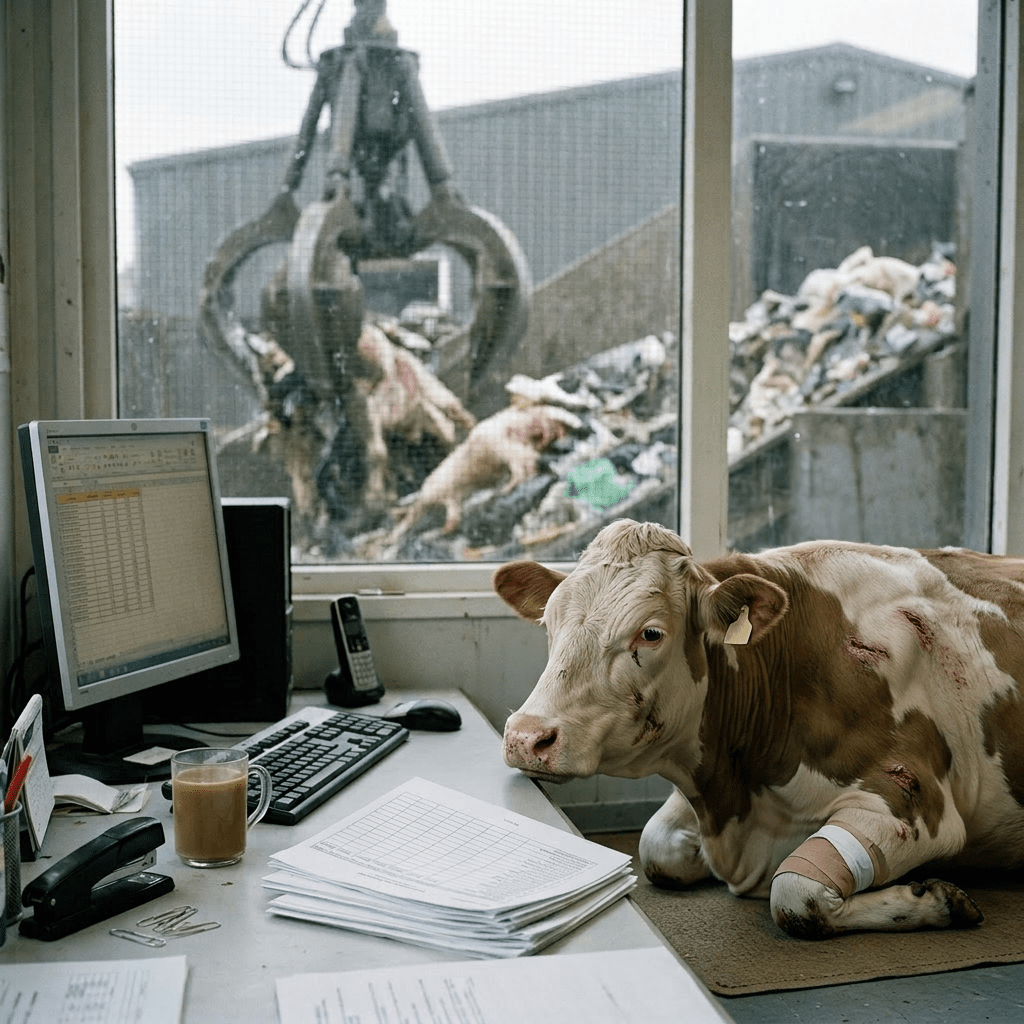
I was not born into a life. I did not grow up running through meadows, enjoying fresh air. My fate was written from the beginning; I did not even have a chance to choose. I came into the world for a task, and I will complete it and return.
My first memory is my mother. I do not know whether she was luckier than me. She had seen grass and meadows, but she was taken away from there. I am not sure whether knowing is better or never knowing at all. She was more exhausted, more stressed than a mother should be. Her body had been used again and again, and when her function was over, she too completed the same task and left.
My first memories are not grass and meadows. They are metal and noise. My mother’s filth and feces mixed with the others. Ours too. We are trying to grow among bodies squeezed into one another. The only thing we breathe is the smell of waste and death. Metal, noise, and wet ground. That is all I remember. Am I lucky because I grew up? I am not sure. Growing up knowing that I will be exploited like my mother is not very pleasant. I could have drowned in that filth like my siblings, or been crushed by my mother. That did not happen.
We never discovered the sun. They say such a thing exists. We saw nothing except concrete, dirt, urine, feces, fear, and blood. We could not even run in fields. We searched for food in feces, drank what was given to us in the smell of ammonia, ate whatever we found. There were times when we were so hungry that we began eating our mother too. At the point where we should have stopped nursing, we continued to suckle at the cost of harming her. It was not enough; we gnawed at the place she had dirtied as if it were food.
We grew, but we did not live. The only things we saw were filth and disease. Those who became sick did not become free either; they did not meet fresh air. We held on to life with medicines. In that closed space, disease spreads easily, but we stayed alive with antibiotics.
We were in a hurry. We had to grow quickly. We had to reproduce more and grow faster. We were supported with hormones. The ones among us who grew best became food on the table more quickly.
Humans never saw the source of the problem. When they themselves became uncomfortable, they invented rules. They banned hormones, but continued to see the animal as an input.
Some say, “There are good farms too,” or the lucky ones are in more sterile places, but still among machines; the even luckier ones roam freely, but the end is always the same. The animal is raised for death.
It is measured by its body, fattened, stunned, killed, skinned, bled, dismembered, packaged, priced, placed on a shelf, bought, cooked, and eaten. This is not a law of nature. It is not the strong crushing the weak either. On the contrary, it is disproportionate power and madness.
At every stage, language protects the consumer. A corpse becomes “meat.” Even the young are eaten. We eat “veal,” meaning a child, meaning a baby. The mother becomes steak, some become wings, some become ham.
Products bought from the market are only packages for us. If we were told, “Kill and eat,” many of us would not eat meat at all. We would not be able to look into the animal’s eyes and cut it, nor could we tear it apart while ignoring its screams.
The Horror of Scale
Even the story of an individual animal is heavy enough. But the real horror lies in the scale of the slaughter we carry out.
Today, around the world, approximately 900 thousand cows, 3.8 million pigs, and more than 200 million chickens are slaughtered every day. For chickens, this means 140 thousand animals per minute. And then there are other animals too.
The balance sheet of suffering is extremely heavy. A supply chain of millions of deaths. The reason is that we are able to do it and because of industrial ignorance.
As the numbers grow, emotions shrink. We normalize it. Unfortunately, the human mind cannot comprehend this magnitude. Distance and numbers erase identities. What has no name is consumed quickly.
Science
Science says that animals, just like humans, have personalities and that they suffer. Animal behavior, neuroscience, veterinary medicine, and welfare research say that many animal species can experience pain, fear, stress, and negative experiences. This creates two problems. The first is that an animal under stress is also harmful to human health. The second, and more important one, is the moral and ethical problem.
Do we accept the moral burden, or do we avoid facing it?
The answer is that we cook and eat animals we cannot even bear to see or smell. Thinking technically, creating efficient cages, fast slaughter lines, extending shelf life, and beautifying packages is not a solution. It is an answer to the question of whether we can use a living being while it suffers. An ethical disaster.
Land, Forest, and Climate
The damage is not only what happens inside the slaughterhouse or the increase in antibiotic resistance. Enormous areas are needed to feed billions of farm animals. Forests are opened up for pasture and feed production. The Amazon and other ecosystems in South America are not being cut down only so that humans can eat soy products. Huge areas are not needed for these products. A large part of global soy production is used as animal feed. It is given to chickens, pigs, cattle, and fish. Then humans consume these animals in the most inefficient way possible. Apart from the ethical side, the taste and product quality are much, much lower compared to an animal that grows in nature.
The strange thing is this: as if destroying the natural cycle were not enough, we make it even worse. A destruction from which there will be no return. First we grow food, then we grow animals. We feed them with food and then eat them. The strong are not eating the weak. The strong are creating what does not need to exist in order to eat.
Meanwhile, while we burn forests, destroy biodiversity, maximize methane emissions, and destroy clean water resources, we enjoy our dinner. A second ethical problem. Does the world belong to us, or do we have a responsibility toward future generations?
On a global scale, a large part of agricultural land is used for livestock. When grazing areas and fields used to produce animal feed are considered together, livestock occupies 80% of agricultural land. Despite this, meat, milk, and farmed fish provide humanity with a much smaller share of global calories. In other words, industrial efficiency works in the exact opposite direction of biological efficiency. While the damage the industry will suffer is constantly discussed, the burden that all humanity together could not handle is not discussed at all. Then we are surprised when we see increasing fuel, flight, and holiday prices, and we are surprised when we see fires, floods, and unusual weather conditions. Unfortunately, humans do not perceive the systemic complexity and interconnectedness of the world.
If we could eat the plant directly, we would not need to use animals as machines and consume them, for example. But because of false protein advertisements, no one intends to change their habits. In today’s world, we are special. Everything is about us.
Livestock is also one of the important sources of greenhouse gas emissions. Livestock supply chains are responsible for about 15 percent of global human-caused greenhouse gas emissions. Livestock is one of the main causes of the climate crisis.
Especially beef and dairy production bring a heavy climate burden because of methane. Methane is not as long-lived as carbon dioxide, and this is the reason for rapid warming. So if animal production were largely restricted today, many problems could ease in the short and medium term.
Antibiotics, Bacteria, and Viruses
Crowded animal facilities create suitable environments for bacteria and viruses to spread. During the Covid period, while making racist remarks like “it came from bats,” we were ethically deprived enough not to see the risk created by our daily routines. The coronavirus was only one of tens of thousands of viruses that carry the risk of infecting humans.
In systems where large numbers of animals are kept in narrow spaces, the risk of disease increases. Antibiotics come into play. The result of this is the increase in antibiotic resistance, meaning we lose the war we are fighting against bacteria. To put it more strikingly, it means the weak die: children, the elderly, the sick, pregnant people. It is certain that we will see more deaths.
Antibiotic resistance, although not discussed enough, is humanity’s shared problem. Because resistant bacteria can spread to wider ecosystems through the food chain, the environment, water, soil, and contact. Today, even the treatment of the most ordinary infection becoming more difficult is one of the most serious risks of modern medicine. This is not a problem that will be solved by saying we do not give antibiotics to a child when they get sick.
Of course, when we build our relationship with animals around eating, it is hard to see this. Human health and animal health are not completely separate concepts. Humans, animals, and nature are parts of the same biological network.
Zoonotic diseases are important for this reason too. Many infections can pass from animals to humans. A large portion of newly emerging infectious diseases are animal-origin. This does not mean every farm creates a pandemic, of course, but when we keep animals in dense, stressful, industrial, and unnatural conditions, we multiply the risk excessively. It is like someone with cancer moving to a place where radioactivity is high.
When we destroy forests, contact with wildlife increases. When we concentrate animals, the likelihood of pathogens spreading increases too. Thanks to global trade, we quickly carry risks from one end of the world to every part of the world. So the issue is not only what enters our plate, but the planet’s own metabolism and balance.
Ethics
The question is actually simple. Like humans, every animal wants to live. To live, space is needed, clean air is needed, movement and light are needed. Not suffering is our basic reflex. No one lives in order to suffer.
Ethically, we should react to eating animal flesh in a way similar to how we would react to someone who wants to eat human flesh just because they are powerful. In both cases, the issue is about power and preventing the right to life.
As humans, if we can think, if we have values and reason, if we have culture, ethical thought, and imagination, then we need to separate ourselves from primitiveness, especially in a period when technology has developed so much. Because what we are doing is not superiority; it is primitiveness and shame.
There is a saying attributed to Gandhi, probably a saying from Indian philosophy:
“The greatness of a nation and its moral progress can be judged by the way its animals are treated.”
The true face of a society is not revealed only by how it treats the powerful, the rich, and the visible. It is not measured by the machines and money it produces either. Development is something more complex. True development appears in how it treats those who cannot defend themselves, cannot speak, and whose pain it cannot understand.
How we treat a child, an elderly person, a refugee, a worker, an animal actually shows how “developed” we are. Because our behavior toward power is often mixed with interest. But our behavior toward the powerless is more naked. Character appears there.
The animal issue, for this reason, is not only about nutrition. It is more a matter of ethics and conscience. This issue begins in our language, our habits, our economy, our perception of the body, our fear of death, and our broken relationship with nature.
When we look at industrial societies, this also lies at the root of what we see as “hypocrisy” in human and political issues. We measure development as industrial production, and this development also enables such separation from nature. The modernism and development we admire is this too: separation from nature.
Separation from Nature
When I see a dead mouse, frog, or other animals on the street or in the forest, I flinch. Then I think about why the most natural event in the world causes such discomfort.
Modern humans live disconnected from nature. When a person sees things they only see once in a while, and sees them freshly dead, naturally they become disturbed.
Then when I think about the whole modern system, people, and the media, I see this: death is extremely negative and distant. Humans do not want to age. They do not want to die, to get tired, or to become exhausted. They do not want to look flawed. As if they will win the war against time, they invest everything they have in appearance: plastic nails, Botox, fillers, cosmetic surgeries, filters, the constant promise of youth, flawless skin, flawless body, and flawless life. All of them are different expressions of the same fear and separation.
Of course, taking care of oneself is not bad, but the issue is that while social norms change, we disconnect from nature and from our essence. We cannot tolerate what is normal, and while doing this, we once again overturn natural balance, harm the environment, and selfishly do not care about it. What is even stranger is that we could solve our hormonal balance and many issues we complain about with a proper diet. Of course, reducing animal consumption is also part of this.
There is nothing more normal in life than aging, getting sick, being born, and dying, but we have begun to see aging as a disease. That is how far we have moved away from reality.
In fact, we have lost our sanity. Everything has become more sterile than necessary, and while the animal turns into a product, we have turned the human being into a project. When we measure everything by production and efficiency, we drown in the same disorder. While the name of the cruelty we inflict on animals becomes production and is displayed on shelves, the human body is marketed as beauty on social media, in clinics, in advertisements, and in mirrors. Even the word beauty has lost its meaning. All of it is connected. It is the result of the natural cycle we broke. In fact, if we included ethics in our measures of development, we would see how much we have regressed.
The Banality of Evil
Hannah Arendt connects the banality of evil to everyday acceptances and routines. Evil does not always come by suddenly burning and destroying everything. Sometimes, perhaps most of the time, it comes from ordinariness and acceptance. Ordinary people, ordinary jobs, ordinary forms, ordinary orders, ordinary procedures, and ordinary institutions.
Even if everything seems to work in harmony, on the contrary, it feeds evil. There is nothing worse than a person who has stopped thinking.
Industrial animal farming is like this too. For the cashier, for the driver, for the worker on the slaughter line, for the food engineer, for companies, or for the advertiser, there is no problem. Everyone is doing what their job requires. Everyone is a part of a small system. No one feels cruel. In other words, violence becomes normalized. It becomes as normal as the sausage at breakfast, the barbecue with alcohol, the iftar table, the holiday table, the chicken eaten at lunch, the milk drunk occasionally, the egg cracked open, the discount used. Are there many people who feel ethical responsibility while dipping bread into an egg? I do not think so.
Do You Have to Cause Harm?
In Indian thought, especially in Jainism, the idea of Ahimsa, which is very central, means non-harm. Not only toward humans, but toward animals, insects, and everything that is alive, causing as little harm as possible. Some people boast that there is respect for nature in Shamanism; this is similar.
This is not romantic compassion, but a sharp question:
“DO YOU HAVE TO CAUSE HARM?”
Modern capitalist thought is built on quantity. More, faster, more of everything. To feed this, prominent individualism is used. You are special, you are beautiful, look younger, be more successful, be smoother, be more perfect. Ahimsa is the exact opposite.
Just because you have power does not mean you have to use it.
Being able to control a living being does not give you the right to use and exploit it. Being able to put it in a cage does not make this a correct activity. Being able to cut and package it does not make that body insignificant.
Today, especially in rich and developed societies, eating animals is no longer necessary for survival for most people. There are many options such as legumes, grains, modern production, vegetables, nuts, seeds, plant proteins, and supplements. Compared to past generations, we have much more information, alternatives, and possibilities. The question is no longer only “Can we eat animals?” The question is: “If we do not have to, why do we eat them?”
There is no end to being able to do something. Today, the rich people involved in child abuse cases that we look at with disgust, those who voluntarily went to Serbia, which we accused of genocide, to experience war, and who “hunted” many innocent people, could also defend themselves by saying, “I could do it, so I did it.” Or similarly, Israel, which the world reacts against, could say this too. The line between one being right and the other being wrong is not as thick as you think.
Veganism, Vegetarianism, and Necessity
Of course, this criticism and empathy toward animals should not be an imposition. Poverty, geography, health, culture, access, and nutritional knowledge are not the same everywhere in the world. Not everyone has the same options and possibilities.
But the starting point of the issue is this: will I knowingly support suffering, or can I reduce suffering?
Some may find a path for themselves by becoming completely vegan. Some may take a step by becoming vegetarian. Some may become conscious consumers by reducing animal products and giving plant-based alternatives a chance. Or by creating their own sustainable reality against industrial production. This is not as impossible as it is thought to be.
Trying to be perfect never works. But we have to be honest. Because the issue is not being good or bad; it is more about becoming aware of our share in the system and how we actually support the things we complain about. My reaction when the forest in my neighborhood is being cut down should not contradict my indifference toward lives disappearing anywhere in the world.
The example of Arendt shows the danger of participating without thinking. This is truly the most dangerous thing. Ethically, there is not much difference between saying, “I only live once, I mind my own business,” and pulling out a gun and killing someone.
As in the example of Ahimsa, reducing harm is actually a sign of moral maturity, and at the same time a sign of development as a human being.
Although science calculates the balance sheet of harm, if we expect change from large systems, we are actually lying to ourselves.
This is actually a litmus test of personality. The greatest indicator of selfishness. Having good intentions changes nothing. Being busy, tired, ordinary; not thinking does not lighten a person, it makes them responsible. For example, when you vote for the systems from which you expect great changes, how many times have you looked at their policies on animals? How many times have you made decisions based on this? How many times have you questioned it and joined or supported movements related to it?
If you have not, waiting only means serving evil. It means you are the biggest part of cruelty. This is not only about animal products, but the same applies to every current issue we complain about. Escaping ethical responsibility is one of the biggest causes of evil in the world.


Leave a Reply