Another day when I chose to be alone. The weather is too gray for socializing.
My head can no longer take people in, but I cannot stay away from people either. I ended up in the café on the corner near home.
Spring is about to end, but summer is not coming either. It showed itself just a little, just when we thought the long winter was over, and then suddenly we went back to cold and gray weather. Rain and storm. Tiny pieces of trash slipping out of people’s hands are flying through the air, the blooming flowers are full of regret. The downpour has started too, so I guess I will stay in the café a little longer. I was thinking about what to do, and then the idea came to me to turn the café into a story. Maybe time would pass.
As usual, while eating my German pretzel, Brezel, and the best thing in Saxony, Eierschecke cake, I started watching my surroundings. To be honest, the panic of people running left and right from the rain does not interest me much. Except for the old man trying to finish his cigarette under the rain, defying those trying to catch the tram. But inside is more colorful.
This time, it felt as if I had gone outside to write, instead of writing just for the sake of having written. Sometimes, even the way a random stranger holds a glass can give you different ideas.
There is a man sitting at the table across from me.
At first glance, he is not someone noticeable. Close to his fifties, wearing a dark gray coat, short-haired, his face divided by hard lines. Sometimes you look at someone’s face and say, this man has lived through a lot. This is not that. This is more like, some things happened, but I do not want to talk about them. Maybe he has closed himself off from the world. Who knows? He looks as if, if someone approached him, he would curse them away.
There is black coffee in front of him. Next to it, a dessert with only a tiny taste taken from its edge. Even that, he chose the most colorless one. He placed another order, but he is not eating that either. Could he be waiting for someone, or does he want to make it clear that he will sit for a long time?
He does not take his coat off. We are in May. The weather is cold, but not so cold that you would sit inside with your coat on. This detail stuck in my head. Why?
There is also a strange calm inside. So calm that I started thinking the half-racist looks we get when we sit noisily would this time come only because of the noise inside my head. Do you know what is funny? In East Germany, just like in our villages, there is a habit of staring at everything unfamiliar. While watching the man, I now wonder whether I have become one of them too. But no, the man is not taking his coat off. While the plate says, I am here for hours, the coat says, I can leave at any moment. The man is wearing a wall. By the way, my coffee has already gone cold. I need to speed up. Maybe ordering a beer would have been better.
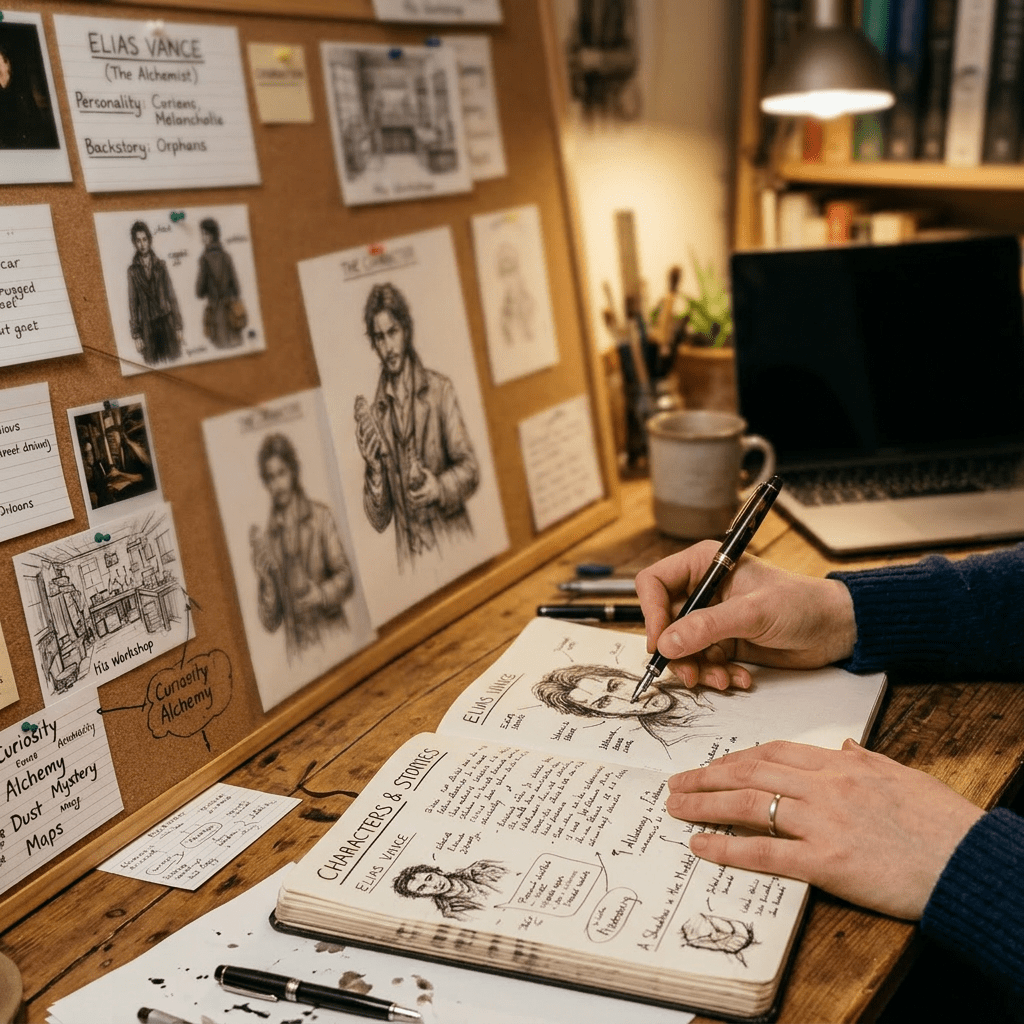
I took out my notebook and started writing.
The man is close to his fifties. Not a tourist, clearly local. Hard expression. He does not take off his coat, does not drink his coffee. He seems to be waiting, but also ready to escape.
I wonder what his name could be.
Not Thomas. All the Thomases I know are cheerful people. Too young to be Klaus. Frank is possible, but he does not seem like that kind of man either. He cannot be Stefan. Ralf. Yes, Ralf fit well. Should I go up to him and say, you look exactly like a Ralf?
Ralf Berger. Cliché, but I think it fits perfectly.
He was born in a small village in Saxony. He spent most of his life around here. He came to Dresden, tried his luck in Leipzig, went to Berlin once or twice, but never felt like he belonged. Some people live like guests in their own country, and he is like that. He does not accept it either, probably, which is why he has a tense posture.
The way he holds the coffee cup, his worn hand and face, shout that he has worked. He probably has small cuts on his hands too. Metal, warehouse, repair work, factory, engine oil, cold morning shifts; it is obvious he has seen them. He reminds me of the workers back home. One of these is definitely there, unless he was a soldier before. Although if he had been a soldier, he would not look this worn out.
When I think about the places I worked in East Germany and the people I observed, if you do not include certain characters, the factory feels incomplete. Usually, all those characters exist there in one way or another. Because here, the factories that closed, were sold, merged, shrank, or moved in the past were not only the economy, but also people’s identity. Their hatred toward the world comes from this too. Losing their jobs also prevented them from feeling useful. And when you add the West’s condescension on top of that, their identities develop, or fail to develop, inside this feeling of being crushed.
When Ralf was young, he clearly grew up with the sound of machines. Ralf, who could understand a malfunction from the smallest change in a machine’s sound, could not understand his wife’s tiredness. Maybe that is why he is sitting alone. Or maybe, like other workers who worked morning and night, after stories of being cheated on, he chose loneliness himself.
There does not seem to be a ring on his finger, but that does not mean anything either. Some people can never wear rings, while others cannot bring themselves to remove the ring even after divorce. I wonder if he never married, or if there is a painful story behind him. I am looking for a few clues, but I also do not want to keep the man under surveillance like a creep.
I made another note in the notebook:
Ralf Berger, 51 years old. Former maintenance technician. Now does part-time warehouse work and small mechanical repairs. I could not decide about his home. Miserable loneliness, or an unhappy order?
Meanwhile, two tourists came inside. They are speaking English. Their hair is wet, and they are looking at the cakes in front of the display case. The other day, I had explained the cakes one by one to a Turkish group. Now I am watching the same scene from the outside. They ask in English, show their phone, and the woman at the register tries to explain half in English, half in German. The tourists laughing at the situation brought at least a little joy to the place. The woman at the register is laughing too.
Ralf suddenly turned and started looking at them. I do not know whether he was disturbed by their laughter or by the fact that English was being spoken. I do not want to label him either. It is too easy to fall into clichés. Maybe it is simply a situation he is not used to. But his facial expression looks as if he connects the change of the last 30–40 years to them. He gave me a similar look from time to time too. Maybe he is just a rude person.
I do not have an idea yet.
But there is something wrong in those looks. As if he has a filter for who belongs in the place and how much. He judges everyone who makes a sound, one by one. The tourists will pass through and leave. It seems like he can tolerate them. But the foreigners who do not leave? Maybe his inner voice is trembling right now. Maybe he is thinking, what has Germany become? Or maybe the opposite; maybe he is so used to his routines and habits that he is only afraid of difference, like many people on the street. Like those who support evil with their silence.
Someone has now sat at the table next to Ralf too. While sitting down, they greeted him. I am seeing Ralf smile for the first time. They had a short conversation. They are not strangers to each other, but they are not close either. So Ralf really does come here often. Could it be every day after work?
The Ralf who had just looked at the tourists with hatred disappeared, and it was as if a completely different man came in his place. Is it the effect of the slightly older woman sitting next to him, or the comfort of seeing a familiar face? I think contradiction is essential for story characters. Not exactly a full character transformation, but small contradictions and unpredictable changes.
I take my note in the notebook again:
Distant toward strangers, but not rude toward others. He can act like a good person. We do not know whether he is good.
Ralf takes a sip from his coffee. He grimaces. The coffee is cold, but he does not change it. It is as if he has accepted the situation like a punishment, but that sip also brought the previous Ralf back.
Meanwhile, the rain has grown much heavier. The famous spring downpours. With climate change and all that, it feels as if we are moving into a tropical climate. At the tram stop, some are trying to hide under the shelter roof, while others have accepted the situation. The old man smoking is still there. He threw the cigarette butt away long ago, but he continues resisting the rain. Maybe a homeless man showing his stance against life, as if saying, this is my posture too.
I turned my head back inside. Time slowed down tenfold. Ralf is watching left and right. He has a look as if he is waiting for someone, but also a little anxious. I fell into the same dilemma again: is he afraid someone will come and does he want to escape, or is he waiting for someone?
I wonder why he is tense. Did he kill someone?
There is no point in loading every evil onto the man either. He does not really look like a murderer. More like someone who witnessed something and had the blame left on him. Like someone who spent years muttering “I did not do it,” and waking up from nightmares. Yes, this is more realistic. More disturbing.
The guilt of someone who kills is clear. The reader keeps their distance. It does not give the desired tension. He is bad, and he is known as such. But a character who stays silent while something is happening is more unknown, more unsettling.
Maybe Ralf stood beside the wrong people when he was young.
The years after the Wall fell. Unemployment, anger, exclusion, being lost. An alcoholic father, a helpless mother. Both of them helpless. The place where Ralf barely managed to work had closed down, bought by a company from Hamburg. New bosses arrived. New words, new forms, new standards, and a new life. Old skills suddenly lost their value. The boss from Hamburg, looking at his employees as if they were insects, gave them the hardest jobs without caring about their lives. Ralf and people like him began to feel even more worthless and outdated. Their hopes of finding work in the West always ended in disappointment.
In this situation, there are two paths to take. Either you start your own business, or you treat someone more worthless than yourself in the same way. Ralf may have moved closer to the second path.
There must be a Karl in Ralf’s past. It feels as if every Ralf has someone like that next to him. A louder, more certain, angrier, more dangerous friend. A type who says exactly what he thinks, feels no shame, and makes you feel innocent. He probably formed many of the sentences, and Ralf usually laughed.
Karl may have pulled Ralf into a group. A circle of friends that started with beer and became stained with drugs. Over time, everyone in the friend group’s life gets worse, but nobody wants to look at their own life. Even though the word “we” now represents danger, they have become “we” already. What is missing? “They.”
Could “they” be the Vietnamese family in the neighborhood?
Minh Tyan.
Minh Tyan. He grew up in the same town as Ralf. His German is accented but fluent. They came during the East Germany period as workers, got passports, but remained “good foreigners.” They cannot become local here, nor native anywhere else.
Minh’s family has a kiosk. Ralf also went there from time to time with his friends. They even studied around the same time, took the same bus. But they could never cross the invisible line between them. In more than ten years, they barely spoke two words to each other. While Minh’s family’s situation improved day by day, Ralf’s situation, like those in his circle of friends, kept getting worse.
Maybe one night, that invisible line was set on fire.
Again, on an evening flowing with alcohol and drugs, glass broke, slogans were shouted. The bottles in their hands were thrown at that kiosk. Maybe the aim was to scare them, or maybe it was a childish act. Ralf did not open his mouth and joined his friends.
No one died in the incident, but Minh’s face was burned. His mother and father were injured. They left the town. The event appeared in newspapers, was condemned in Berlin, but everyone returned to their lives.
Maybe that is why, when the tourists came in, Ralf got stuck on the smile of the Vietnamese woman at the register. Not hatred toward them, but hatred toward himself.
While I was thinking all this, I was left alone in the place. A man wearing a football jersey and scarf came over to Ralf. Typical. His face was red from drinking beer and eating meat, his cheeks swollen, but unlike Ralf, he was cheerful.
As soon as Ralf saw him, he put his cup down and straightened up in his chair. The man turned to Ralf and said:
“Na, Berger,” and dropped himself next to him without asking permission. Ralf replied with a slight, unwilling smile, but kept his silence. Actually, I do not know what he said, but I imagined it like this.
The man was exactly the missing character in the story. Karl. As soon as he sat at the table, he scanned the foreigners in the place, including me, and said something to Karl with arrogant gestures. Karl became even more serious. As if he used to laugh at these kinds of things in the past, but had finally found the courage to oppose them. Or not objecting could also mean that he approved.
At that moment, Karl is searching for something on his phone and showing it to Ralf. Ralf’s face turns sour again. As if saying, now? Where did this come from?
I imagined a dialogue like this:
Why are you hiding this now?
Sometimes you think something is over, but it is not. People prefer to hide unfinished things. So they know where they are when they look for them. As if the meeting of old friends is an excuse, and the real face of the matter is blackmail and the message that I am the powerful one.
Karl seems to enjoy what he is doing and seeing Ralf thoughtful. “We are meeting on Saturday,” he says.
Could this be a reference to the demonstration on Saturday? The participants of the demonstration for which the police are taking precautions, maybe even the leader, is this Karl. Keywords are circling around: “security,” “homeland,” “refugee”…
Karl leans in and says something to Ralf. Whatever the content is, Ralf grips the glass more tightly. It is hard to say whether it is anger or tension. It is clear they are not talking about the match.
I made another note in the notebook:
He said we will only talk. Like before, we will scare them and make them leave, nobody will get hurt.
Ralf’s face explains everything. As if his life has been trapped inside the word “only.” Like the word “but” in our language. He comforted himself this way, protected his silence this way.
The slowness in the place seemed to reverse. Everything became more lively, noisier. Everything is in a rush, except Ralf, who is staring blankly. The world has no respect for such moral moments. On the contrary, as if doing it out of spite, the waitress dropped a glass and broke it. Karl burst out laughing. He also shouted, “I told you.”
Maybe for the first time in his life, Ralf gathered his courage and showed his reaction. Again, it was not a loud reaction, but he made it clear that he was ashamed of what Karl had said. It instantly covered the smile and joy on Karl’s face.
This scene will not make Ralf a hero, of course. I think it is more of an inner conflict. A questioning of life. Ralf, who was dragged down the wrong path by the crowd and made his own life poisonous, this time managed to show his stance with the courage given by the crowd. What he did will not clean his past or make the events that happened disappear. It will not stop the march planned for the weekend either, but at least it completed a character I can use later.
Ralf Berger; the colorless man with the hard face and dark coat. A man cautious toward strangers, but able to reflect, even if only a little, the goodness inside him toward those like himself. A life spent with machines turned him too into a cog in the machine. He stood beside the wrong people, fled from the night of the fire, but always felt the guilt. He is definitely not a good person, but he is not evil either. He stayed silent most of his life, and by staying silent, supported injustices. After passing his fifties, he questioned his stance in life and realized that he did have one.
When Karl got up and left, Ralf did not even look after him. He drank his cold coffee with the pleasure of drinking something warm.
Now it is time for me to pay the bill and leave. The rain has also eased quite a bit. Outside, life has already returned to its normal speed.
I make one final note:
The consequences of the choices we make eventually circle back and find us. Sometimes as an old friend in a football jersey with a red nose, sometimes as a smiling acquaintance. When you learn to face them, even bitter cold coffee can be drunk with a strange peace.


Leave a Reply