
I am finally finishing the series on disruptive technologies. Although the word “disruptive” may sound negative, I mentioned that its meaning is actually “things that fundamentally change our lives.” In most of the previous examples, I talked about how these technologies carry many ethical issues alongside their benefits. Now, I will write about technologies that have produced more positive outcomes, that we have quickly adopted, and that have led cultural transformation.
Throughout history, technology has changed our lives in many ways. Just like human behaviors and lifestyles, culture has adapted to change. This transformation increased justice, improved health, reduced difficulties, and pushed humans beyond their potential. Contrary to traditional thinking, culture, traditions, and customs are not fixed things. Every year, we change both individually and socially. Our ways of thinking, our lifestyles, our actions, even our ways of socializing try to keep up with time. Those who fail to adapt to this change simply disappear.
1. Stone tools and Fire
The technology of every era is different. In prehistoric times, stone tools and fire were major technologies. Thanks to these, human eating habits changed, the evolutionary process accelerated, and vulnerabilities decreased.
As humans started cooking food, food safety increased and the nutritional value of what they consumed diversified. With the tools they made, they improved hunting, became better at protecting themselves, and were able to build more durable shelters. Another outcome of this change was socialization. Shared resources and cooperation for better hunting gave rise to social organizations from the most primitive communities.
2. The Wheel
I find the invention of the wheel interesting from a different perspective. Its relationship with industrialization years later has always seemed fascinating to me. It is essentially the same revolution happening again thousands of years later.
Thanks to the wheel, human mobility increased. Humans were able to move from one point to another while conserving energy. This allowed them to spread over larger areas and contributed to the growth of trade partnerships. They could also transport goods over longer distances more easily. This prevented them from being confined to their own regions. The foundation of today’s society is actually based on this mobility and transportation power. We experienced this better especially during the pandemic period.
3. Writing systems
Before writing, communication was based on storytelling. The game we played in primary school also shows how unreliable this is. Information passed from ear to ear gets lost and altered because perception and emotions come into play.
With writing, humans began to possess collective knowledge. History, law, and literature developed, and as these developed, societies also progressed. People began to learn from history and create shared values. Even though written law can still be interpreted differently today, a common ground can largely be found. The invention of writing fundamentally changed not only knowledge and cultural ties but also the understanding of governance.
4. Iron and Bronze Tools
To put it very briefly, iron and bronze created empires. Production accelerated, agriculture advanced, yields increased, and infrastructure strengthened. Humans reached a point where they could better protect their territories. Although it also brought more bloody wars.
5. Printed Media
We are taught that the late arrival of the printing press caused the collapse of an empire, but why does it cause collapse? Without writing and books, we would keep blaming other things and deceive ourselves by saying that if things were different, we would now be ruling the world.
Thanks to printed media, the monopoly of elites, kings, and in Europe the church over knowledge came to an end. Education and literacy spread to wider populations. Science spread across the world and began to develop through collective knowledge exchange. It paved the way for a cultural awakening. The biggest reason for the Reformation and the Renaissance was this.
It was a major step for democracy, critical thinking, creative thinking, and education. Of course, kings and rulers tried to prevent this awakening. By cutting access to information and banning printed media from entering their countries, they thought they could maintain their rule, but that was not the case. People paid the price of this great mistake for centuries. Even today, we are still paying the price. The struggle between uneducated societies and those fighting for education and freedom continues. Tyrants who gain power from ignorance think they can maintain their rule by restricting access to information, just like their ancestors did 500–600 years ago. However, you cannot stop anyone who has tasted freedom, knowledge, and democracy. The 300-year collapse process in the Ottoman Empire could happen in 5 years today. Just like technology, the flow of events has accelerated.
6. Scientific Method
Not only the printing press arrived late to our lands, but the scientific method did as well. The scientific method eliminated explanations based on superstition and belief. It replaced them with evidence-based knowledge, cause-and-effect relationships, and modern science. Thanks to this, humans made rapid progress in medicine, physics, and biology. We reached today’s technology and reduced the harm of pseudoscience and myths. Humans do not change easily. Even today, people still follow pseudoscience and superstitions. They create their own myths and believe in them. Nevertheless, the scientific method continues as the fundamental truth of life.
7. Industrial Revolution
From the wheel to writing, to printed media and modern technology, humanity arrived at the industrial revolution. A revolution made inevitable by advancing technology. This revolution destroyed local and overly controlled labor economies and traditional craftsmanship. In return, it brought faster development, better trade networks, more affordable production, and a more accessible world. Through the industrial revolution, we encountered capitalism and international trade. The result of this trade was mutual dependency, making wars increasingly meaningless over time.
Of course, nothing comes easily. We also witnessed slavery and lives lost among machines, but these experiences also brought workers’ rights. New systems emerged. Today, we are still evolving by learning from these systems.
Within this evolution, we realized something else: natural resources are not infinite. Constant production is destroying our environment. Therefore, the continuation of the industrial revolution brings labor, social, and environmental reforms. It paves the way for more social policies and a shared living experience.
8. Electricity
There is no need to explain electricity much anymore. Imagine a one-month power outage. No refrigerator, no computer, no internet, no phone, no communication. Nothing can continue because everything is digitalized. No crime records, no cameras, no transportation. Can you imagine how disruptive it is and how it changed our lives? We cannot imagine life without electricity. Yet, in the 300,000-year history of humanity, we have only had electricity for the last 200 years.
9. Internet and Smartphones
The internet and smartphones eliminated written media, CDs, and even borders in terms of communication.
Now everyone is aware of everything everywhere, and borders have no meaning. We handle many tasks through the internet, and things that once required large rooms and physical movement can now be done with the device in our pocket.
What this brought us is global access. It is possible to access everything from anywhere. For example, you can order a product from China while sitting in the bathroom and have it delivered to your door. You can reach anyone instantly, even with video calls. From generations who waited months for letters and suddenly forgot all their worries upon receiving one, we have become generations who get upset if they don’t see a blue tick, who overthink when they don’t get an instant reply.
A digital economy has also emerged. Many jobs can be done online and money can be earned. The internet has become life itself, and we are moving toward a more virtual reality. We will get used to that too.
10. Artificial Intelligence
In my opinion, after the wheel, writing, the printing press, and the industrial revolution, artificial intelligence is one of the biggest revolutions we are starting to miss again. Artificial intelligence entered our lives very quickly and is used everywhere. It works in the background of many applications and websites.
Artificial intelligence has ended manual analysis, eliminated repetitive tasks, and is removing the limits of human capability.
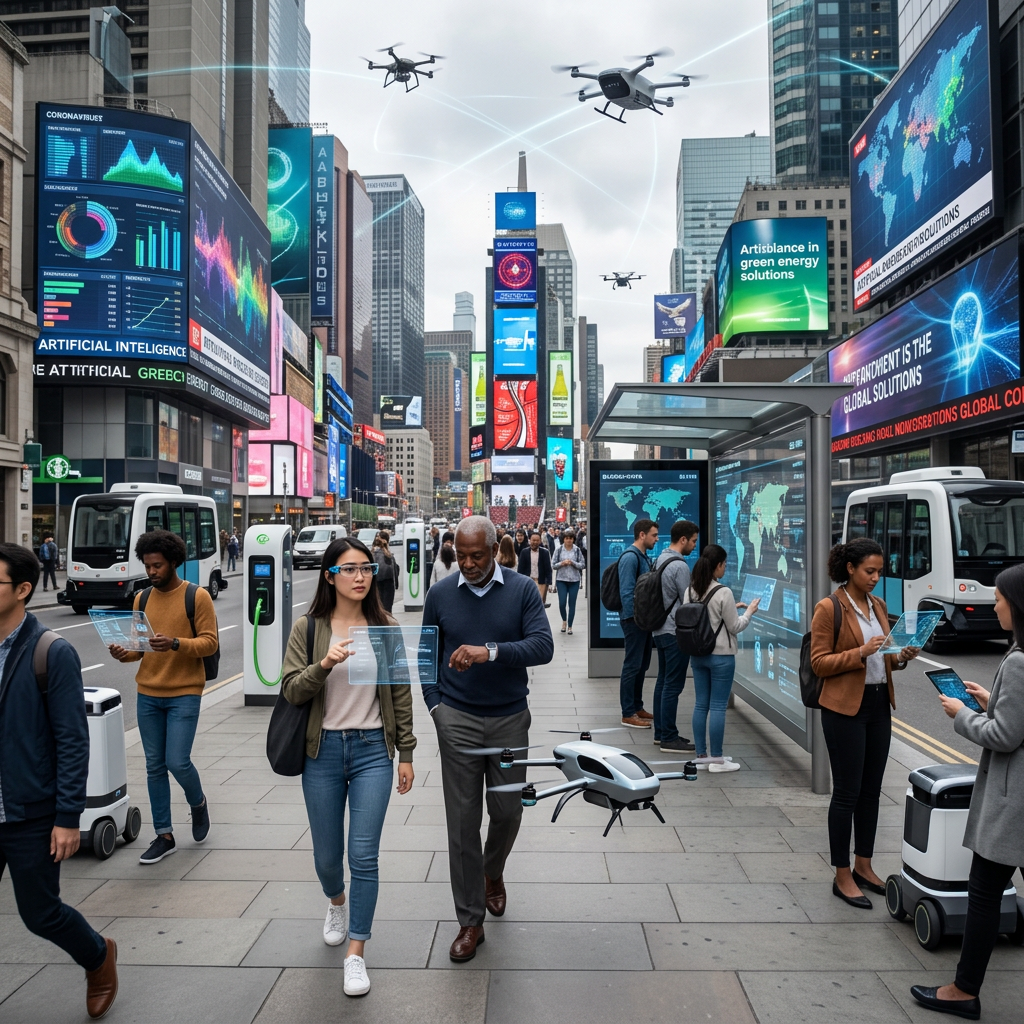
Thanks to artificial intelligence, we are moving toward a major revolution in the medical field. Our lifestyles are changing. Many creative applications are entering our lives and fundamentally transforming how we perceive art, music, and knowledge. With smart systems, everything in life—our homes, cities, and social communication—is changing from the ground up, and this change is inevitable.
To keep it short: culture, lifestyle, beliefs, traditions, customs, perception… everything is forced to change over time. Some resist change, but without realizing it, they are already adapting. We adopt many things instantly and so deeply that we cannot even imagine life before them. The best examples are electricity and the internet. Another example is the food we buy from markets. Now it is artificial intelligence.
Standing against this change is meaningless. The only responsibility of humans is to understand its impact—both positive and negative. More importantly, to realize that what we believe in is no longer what matters. The only thing that matters is being aware of living together, of what happens beyond ourselves, and of shared spaces. In other words, empathy and respect.
Disruptive technologies are not the end of the world, but the beginning of a new one. Changes that remove our boundaries. Changes that make us more effective, more democratic, and more inclusive.
Let me repeat: humans and human values are more important than ever. Ethics, wisdom, education, and vision are more important than anything else.
 bahadirhancicek
Leave a comment