Morning alarm rings. Snooze. Again. Again.
You’re right. Life is already hard. You don’t have to solve humanity’s crisis before even getting out of bed.
You open your phone.
A bit of news, a bit of discounts, a bit of gossip.
Your brain gets tiny rewards. Filling your mind with just enough junk and getting a dopamine hit feels good. What if the world burns? Scroll past. Everyone’s burning anyway. As long as you’re not.
A fair feeling. A basic survival instinct. “Let the snake that doesn’t bite me live a thousand years.” Let the world do whatever. Let it hang, let it kill.
Not my problem.
You need to shop today. T-shirt, shirt, jeans.
There’s a sale. Can’t miss it, right? What you wear is already outdated anyway.
Where was it produced?
Asia probably. Or Turkey. What would change if you checked anyway?
One click. At your door. Free shipping. Free shipping just hits different. Someone, somewhere might be paying for that “free,” but anyway.
You work out. You need protein. Meat section. Lamb chops look great.
Does it matter how the animal lived, what it saw, how it died? Medium steak, nice lean chops… hmm. Not lamb, it smells. Fine, lamb, you saved the day again.
Market, butcher—doesn’t matter. Just pack it and give it. We’re not going to carry the animal’s conscience too!
A new phone model is out. Better camera. Longer battery. Looks the same, but still. You only live once.
All very logical and healthy decisions. Most importantly, your happiness and mental health.
If war is far, it’s news. If it’s close, it’s trauma. And news always leans negative, darling.
They massacred an entire village across the border—but whatever. They’re not one of us. Let it be worse for them. If they were ours, I’d be sad. Two flags, a leader shares, a couple of fancy words, I do my national duty. As they say, life goes on.
Exploitation? Political. Are we supposed to fix companies?
Global warming? Abstract. Disasters happened before anyway.
Hunger? Forget it. My kitchen is full. Forget all that—residence living is a must. That other neighborhood? Not safe. You never know who’s who. Inside the walls, it’s safe. We even have security. Anything ugly might be happening inside, but at least we don’t see it. An educated, experienced crowd. Sometimes a bit too experienced, but still—at least they’re not poor, not refugees, not beggars.
The walls are solid. They block sound, sight, and reality. And it’s a good neighborhood.
“I’m not harming anyone.”
My favorite sentence.
You’re not beating anyone.
You’re not chaining anyone.
You’re not torturing anyone.
Well, good thing you’re not.
You’re against child labor.
Against animal cruelty.
Against rape.
Against human trafficking.
You’re very clear about these. You might even demand execution. When needed, you disturb your comfort and post a couple of tweets. Bravo. How sensitive you are!
Discount T-shirt, coffee in a cardboard cup never leaves your hand. Your phone looks good. You don’t skip your meat at the market. What more do you need?
You’re not harming anyone. You’re just living your life.
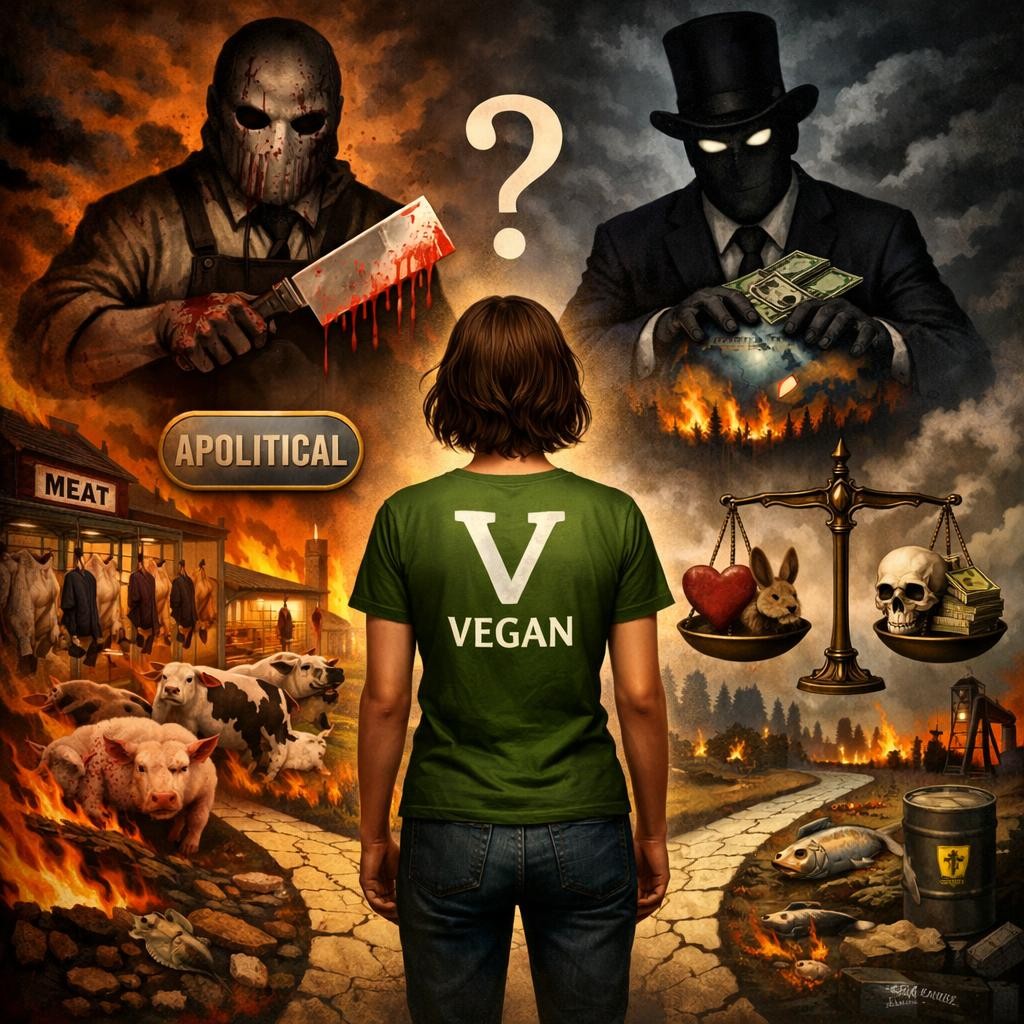
“I’m apolitical.”
Can one really be apolitical? It sounds nice.
Calm. Balanced. Neutral. Or more like:
“I don’t care how the system works, I focus on my money. I benefit from the results.” A bit hedonistic, a bit utilitarian. Isn’t everyone like that?
Cheap labor? Political.
Energy, agriculture, war, migration, taxes—aren’t these political?
Don’t stir things up. Let’s not ruin the mood.
Everything you eat, wear, and use is political.
Shh, don’t complicate it.
Politics isn’t shouting matches or party loyalty. It’s not people yelling at each other. It’s not blind obedience.
Politics is awareness. Being aware of your surroundings and life. Being apolitical is also a political choice. A choice to stay in the comfortable side of the system, accept default norms, normalize what’s wrong.
It’s also an ethical choice. Just like worshipping power, admiring show-off culture, glorifying money and status through movies, chasing gossip, accepting exploitation, sexism, discrimination under the name of fashion; counting heads under nationalism, turning others into enemies, thinking you are superior—these are ethical choices too.
“There’s a product, shouldn’t we buy it? If I don’t, someone else will.”
“Should we shut down the shop? If it’s bought, it will be produced.”
“Aren’t those kids capable of working?”
When it’s someone else’s, it’s easy to consume. Just like children. In principle, everyone is against child exploitation. But if it’s not their own child, they might buy a toy made by another child and make their own happy. Because the label says 200 lira. It doesn’t say: 200 lira + 20 years taken from someone’s life + a sick sibling to care for + ears that can’t hear + pneumonia attacks from working for survival.
No need to be dramatic. These are our daily normals. If we hear about ethical production, we dismiss it as hippie nonsense anyway.
“What can I do alone? Am I going to save the world?”
Yet you know how to boycott over trivial things. Or chase a product to the ends of the earth when you like it.
So yes, there are things you can do alone. You’re just selective.
You hide behind morality and conscience to cover your lack of ethics. Not because you are moral, but because you’re afraid to give up comfort.
We say education is essential. But education isn’t the formulas you memorize or the degrees you stack. It’s not forcing your children into what you couldn’t achieve. It’s not learned terminology. Education is empathy, understanding the world, being human, being sensitive.
And reading isn’t about quoting lines. It’s about understanding pain, stepping into those bodies in novels. Not getting lost in simple love stories or pretending to be intellectual with Russian literature quotes. Not accepting what’s written as truth. Reading is questioning, evaluating, becoming aware. Novels are life itself—sometimes hidden in fantasy, sometimes in simple stories—but they are life.
If you see some starving while others overflow and stay silent, if you see some fleeing while others build safe walls and think it’s normal—then you cannot speak of education, reading, or intelligence.
These days it’s popular. We’re disgusted by Epstein. By dictators. By war criminals.
“They’re monsters.”
They are. But did they become monsters overnight? I doubt it.
The morality and conscience you hide behind creates those monsters. Your lack of ethics makes you a hypocrite.
Worship of power, glorifying money, “everyone does it, why shouldn’t I?”—this mindset creates those monsters. From their perspective, everything is normal. The only difference is, they can do more than you.
In daily life, you do the same. You admire power and show. You glorify wealth. You shape yourself for status.
Those “monsters” are just the extreme version of the culture we live and sustain. When it goes that far, your surprise surprises me.
The worst character of the 20th century was supported by the majority of a society. If you asked individuals, no one would defend poisoning people, burning them, experimenting on them. Yet it happened. It was normalized step by step. It still is.
The reason we’re surprised isn’t innocence. It’s refusing to accept our hypocrisy.
Is a soldier killing thousands worse, or someone killing one person for pleasure?
Is a dictator worse, or those who elect, support, and ignore him?
Is a factory poisoning water worse, or the consumer who keeps buying from it?
Is staying silent to protect comfort worse, or staying silent for profit?
Is admiring an influencer’s life worse, or exposing them for attention?
Is the engineer who designs a bomb worse, the one who drops it, or the one who celebrates it?
Is destroying the Amazon worse, or calling the destroyer a genius?
Is forcing a child to work worse, knowing and continuing to buy, or hearing and pretending not to?
Where exactly is the boundary of evil and morality?
We perceive evil as physical, but nothing is as dangerous as comfort.
Like supermarket shelves, comfort increases ethical distance. Shiny packaging silences conscience. The more products, the less reaction. Stories lose meaning.
Like packaged meat. Evil sells fast. The aesthetic we chase, the protein needs we justify, the meat we demand. And the animals produced and tortured for it. We consume more meat than ever in history.
If everyone had to kill their own meat, probably 90% of the world would become vegan.
Packages are the choices we make over ethics. A censorship over conscience.
When I think about these things, I always remember a misunderstood man: Diogenes of Sinope.
When he told Alexander the Great to “stand out of my sunlight,” he probably didn’t imagine becoming a slogan for selfish indifference centuries later.
Was his message really not caring, or was it satire?
How else could he express refusing to live under the shadow of power?
Diogenes, who lived simply against artificial rules, status, wealth, and fame;
who defended virtue over power and money;
who saw self-sufficiency as the greatest freedom;
who mocked society’s hypocrisy—
his words turning into an apolitical slogan meaning “leave me alone, do whatever you want” is tragic.
Are you comfortable because you don’t see, or do you not see to stay comfortable?
Those you call disgusting could also say “you only live once” and walk away. They might say they do things because they can. You would too. How do I know?
Because you’re not surprised anymore. You normalize things, saying “I knew it.” Just like you normalize many things in your daily life.
A simple example: how much attention does a rape case get? What if a famous person is involved?
How much do the victims on page 3 news affect you? What if they’re famous or foreign?
You think you live without harming anyone. Those people you find disgusting also think they’ve done nothing wrong. They’re too powerful to see you. You’re too comfortable to see those below you.
Even a simple discount decision you make costs someone else their life.
Being apolitical, ignoring consequences, consuming endlessly, staying silent—these are personal choices. Even if ethically empty, they are personal.
But their consequences are collective.
 bahadirhancicek
Leave a comment