
Türkce icin: https://bahadirhancicek.com/2024/10/28/yikici-teknolojiler-6-yapay-rahim/
Although I briefly mentioned it before, I wanted to elaborate a bit more on the topic. Because I find it quite fascinating and I believe it is a technology that could fundamentally change life. (Yes, science and belief together.)
In fact, the concept of this technology dates back to the 1930s. It was first tested on a lamb in 2004, and in 2017, it was shown for the first time that development could occur within this environment.
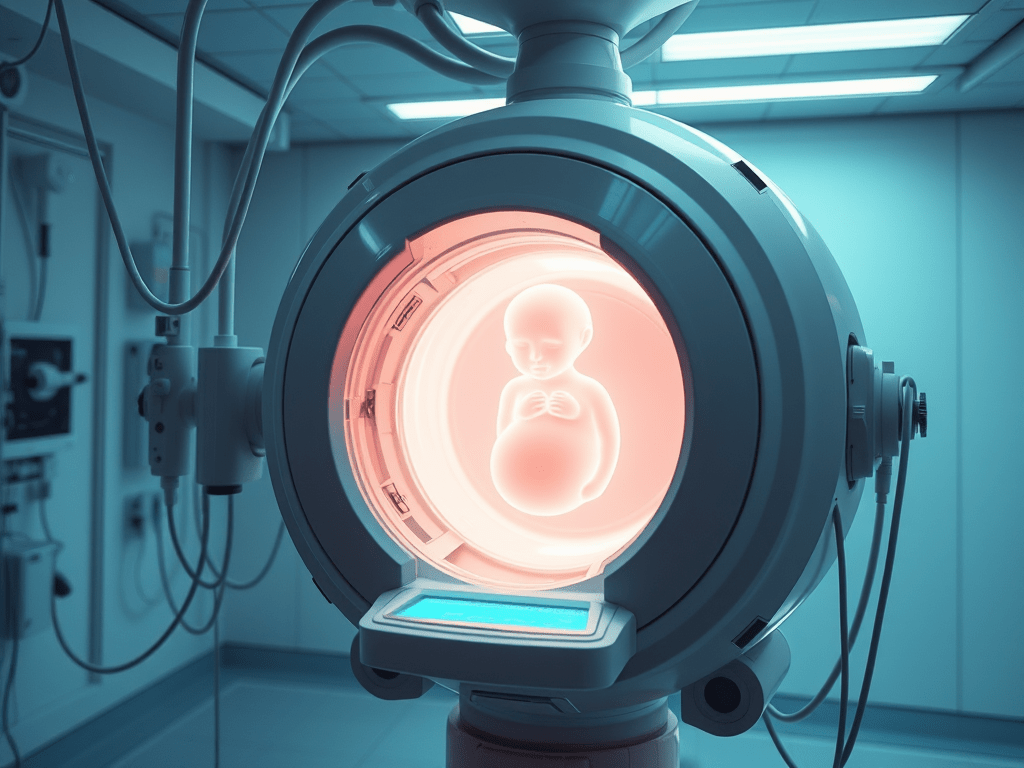
The purpose of the artificial womb is to replicate the process from embryo to birth outside the body in animals. There are two types of this. The first is a fully laboratory-based, controlled environment. The other is creating a similar environment within the body. The goal:
To prevent the difficulties and risks experienced during pregnancy and to support the mother. To help a prematurely born fetus complete its development.
An artificial womb, just like a natural womb, supplies nutrients and oxygen to the fetus, removes waste, and regulates temperature and fluids. In other words, it has the potential to provide a more optimal and stable environment than the mother’s womb. Wouldn’t such an environment be better than an alcoholic mother?
Of course, when explained like this, it may seem as if everything is already complete and we have a ready product in hand. That is not the case. Both the technology itself and its potential applications are still under development. However, experiments conducted on animals are producing promising results.
The natural womb provides the optimal environment for a baby’s development. Its biggest advantage over an artificial womb is the transfer of antibodies from the mother, the development of the microbiome, and thus a stronger immune system. Beyond that, the birth experience leads to the release of more oxytocin (the bonding hormone). This helps the baby feel safer, strengthens the bond between mother and child, and contributes to lower anxiety and better social skills later in life. In other words, life begins in the womb.
Additionally, research shows that emotional stability, self-confidence, and cognitive development also begin in the womb.
It has also been observed that babies develop their senses while in the womb.
The fetus begins to perceive sounds, react to changes in light, and make small movements. The mother’s voice and heartbeat are important variables for early brain function and are also calming for the fetus. Many aspects such as stress responses, chronic diseases, social communication, and emotional fluctuations in later life are influenced by the time spent in the womb. Naturally, this period directly affects later brain development, language perception, and motor system development. These abilities have been observed to be impaired in premature births.
In other words, a healthier pregnancy leads to healthier individuals.
Although the artificial womb is initially presented as a solution for unhealthy pregnancies, its emotional impact is far more complex.
Current Use
Today, this technology is used in animal research, developmental and evolutionary studies, veterinary medicine, and the preservation of endangered species. Its use for supporting prematurely born babies—bridging the gap between traditional birth and specialized medical care—is expected in the coming years.
If ethical issues are addressed, it could also be used both for research purposes, as an alternative for mothers who cannot carry a pregnancy, and to allow same-sex couples and fathers to participate more in the pregnancy process.
The most striking example of the psychological effects of separating a mother and child can be seen in industrial farms where animals are raised for meat. Calves are usually separated from their mothers within one or two hours after birth. The mother is forced to produce milk for humans. The result is changes in social behavior, increased aggression, anxiety, stress, muscle tension, and negative changes in herd behavior.
Challenges Facing the Technology
The technology is not as easy to develop and implement as it may sound. It brings many challenges and complications. The first difficulty is replicating the optimal environment provided by the natural womb. Since many microscopic interactions are not fully understood, and questions remain about how these affect birth, it is not yet possible to recreate this environment completely. Question: What is being sacrificed?
Another challenge is ensuring safe oxygen supply and proper development of the circulatory system, brain, and other organs, as well as monitoring environmental influences. This requires highly detailed and comprehensive research.
Another issue is studying long-term effects, which again demands deep and extensive research.
There are also many legal challenges. The lack of sufficient laws, regulations, and standards, questions about what should be done if environmental factors negatively affect development, and under what conditions this technology should be used as treatment are all still open for debate.
Social and ethical concerns also remain significant barriers. We will examine these more closely.
When it comes to humans, all of these aspects must be carefully considered. But when it comes to animals, experiments are often conducted without hesitation—which, in my opinion, is a serious issue.
Social Change
This is not just a technological or legal issue. Socially, it is also highly complex.
First, it could fundamentally change our understanding of motherhood and parenthood. The roles within parenting could be completely redefined.
Birth is both a physical and psychological experience for the mother, while the father typically plays a supportive role.
With artificial wombs, these roles may lose their meaning, and anyone involved in caring for the baby could be considered part of the “mother” role. This could allow fathers to be more involved in the development process and form stronger bonds. For the mother and baby, however, the situation could be the opposite.
Similarly, this technology could be a major change and opportunity for same-sex individuals. The normalization of alternative family structures could be a significant development. It may also challenge patriarchal perceptions, shifting the definition of parenthood from a biological function to a caregiving role.
Another social impact relates to gender roles and equality. Today, there are many inequalities between men and women, one of the most obvious being career disadvantages.
The biggest reason for workplace disadvantage is pregnancy. With this technology, greater equality could be achieved, and pregnancy might no longer be a barrier to a woman’s career.
It could also challenge the perception that womanhood is defined by the ability to give birth. As alternative family structures become more common, pregnancy may no longer be seen solely as a woman’s responsibility. This could contribute to a more equal and inclusive society.
These changes would transform family structures and perceptions, inevitably affecting internal family dynamics. The potential psychological and sociological impacts are another major question.
Finally, access to this technology could create significant social divisions—between those who can access it and those who cannot, and between those who see it as modern and those who support traditional birth.
ETHICS
From what has been written so far, the ethical dimensions are already clear. Artificial womb technology is far more complex than it appears. Issues such as identity, autonomy, and individual rights must also be considered.
From a human rights perspective: At what point does a fetus gain the rights of a human being? If, unlike traditional birth, different stages of development allow for “birth,” what determines this decision? These questions highlight the need for clear and strict regulations.
Another fundamental question is: What does it mean to be human? What is a “natural” human? The answers, as well as issues like identity formation and social belonging, will challenge both individuals and society.
From a family perspective, there are also legal gaps. Questions about parental rights and responsibilities remain unresolved. For example, if a fetus requires medical intervention, who decides? Who bears responsibility?
In Germany, both parents are prepared for birth through prenatal education. Even if a doctor recommends placing the baby in intensive care, families have the right to refuse. In the case of artificial wombs, families may also be expected to make decisions—but based on what criteria? If something goes wrong, how is responsibility shared?
Children born through this method must have the same rights as others. Otherwise, there is a risk of them being treated as experimental subjects. Continuous monitoring and data tracking for research purposes would raise serious ethical concerns, as it would create inequality in rights from birth.
Another concern is that direct access to the fetus could open the door to DNA and genetic manipulation. This could lead to “designer babies” based on appearance, intelligence, or health, turning babies into products and creating social pressure. It could also lead to non-medical uses of the technology.
The famous Chinese basketball player Yao Ming was the result of a genetic project. His parents were the tallest basketball players in the country, and their union was encouraged by the state. The result was Yao Ming, standing at 2.29 meters. With artificial wombs and genetic manipulation, such practices could become far more common. Humanity has never stopped challenging nature, pursuing immortality, or striving to become “superhuman”—and likely never will.
As mentioned earlier, long-term effects are unknown. Psychologically, these effects could be critical. There may be developmental disadvantages, as well as impacts on identity, mental health, and social integration. The effects observed in animals could be even more pronounced in humans. Bias, self-acceptance issues, and identity struggles may arise.
Finally, a familiar ethical question applies: Who should regulate and control all of this? Governments? Corporations? Medical institutions? You can see the risks, right?
Is it about creating a controlled society and enforcing uniformity? Opening the door to monopolies and limiting freedom? Or allowing market competition at the cost of health and future risks? Or unknowingly becoming test subjects?
Of course, it doesn’t have to be this way—but the risks are significant. We have not even resolved these issues with social media yet, and addressing them for more advanced technologies will be even harder—especially as society adopts and normalizes new technologies without much awareness.
Conclusion
The reason I focused on artificial womb technology is its uniquely broad ethical spectrum. It affects many areas and has the potential to completely reshape traditional perceptions. While it offers solutions to many medical, social, and psychological issues, it also introduces just as many new challenges. This makes careful and comprehensive evaluation essential.
In fact, all technologies are like this. Systems have become complex and are no longer created by a single individual. The components that make up a system do not fully understand the whole. Once the system is built, it is impossible to fully grasp all its technical and social implications. Many effects only become visible through use and experience. In other words, we are always one step behind technology.
To get one step ahead, I believe the answer lies in transparency, technological awareness, and social dialogue.
As long as both creators and users of technology remain transparent, as long as legal frameworks are openly discussed, and as long as both advantages and disadvantages are evaluated honestly and collectively, we can address ethical challenges more effectively.
Education and awareness about technology also play an important role. As people better understand the processes, the influence of conspiracy theories, blind adoption, or uninformed resistance can be reduced.
At its core, the fundamental question remains: What is human nature? A question that has remained unanswered for thousands of years.
 bahadirhancicek
Leave a comment