Another ordinary morning. My body is still not convinced by the world. Muscles drawn inward as if they will never open, bones that seem to have forgotten how to work, as though they are on strike against the brain.
I could pour oil between my joints and it would make sense. My body creaks like a mechanical part that hasn’t been used for years. It has no intention of loosening up. My mind isn’t very willing either. With the light intoxication of sleep, it wants a little more rest. If only it could preserve this emptiness, untouched by any external stimulus.
Reality, however, lands like a blow against this quiet rebellion. Another day. I don’t know how much has passed, or how much is still to come. It’s an age like this—neither the first fire, nor anywhere near the end. The beginning is far, the end is too.
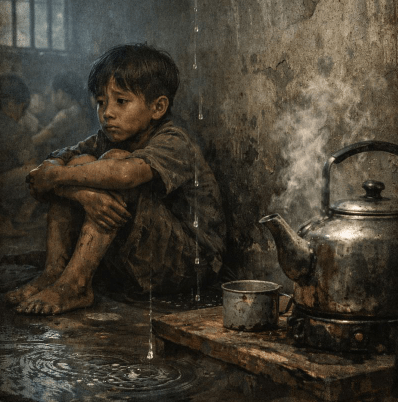
Eventually my body warms a little and I rise for a new day. Until my feet get used to the cold floor, I do what I always do: I fill the kettle.
It fills too fast. What’s the hurry? I know I should pour the water slowly, but I can’t. It’s as if I want it over with. As I pour, the water strikes the kettle’s surface, splashing, scattering. The rings forming on the surface seem rushed too—colliding with one another, disappearing. From where I sit, I watch this chaos with quiet amazement.
When the kettle starts working, a thin hum rises. The sound tightens my chest. It feels like something bad is coming. Rain used to sound like this. Not from the sky, but as if it came from everywhere at once. They said it was good for the soil, but it never was for me. Everything turned to mud, running became harder. As if staying dry were a crime, everyone got soaked and smelled the same.
As the water stirs and the bubbling grows, my mind goes to that truck. The one that rattled across puddles, making noise from every part of it, as if it might fall apart at any moment.
It was green. There was nowhere to sit. We stood. I can say now that it was crowded; back then, all I could see were legs pressed together and the silence of death.
“Don’t cry,” parents whispered to their children.
“If you cry, we’ll be noticed. If you want to live, stay quiet.”
We buried our faces in our mothers’ shirts. I don’t know if it was fear, but it was certainly something unnatural. I can’t forget the smell—rice and smoke. Smoke mixed with mud and rain.
There was a sharp click. The truck stopped. The door opened.
They took us to a school. The teachers had been replaced by men in uniform. On the blackboards were sentences I couldn’t understand. Parts of the walls were stained red. Other areas were still wet. The windows were barred. Just like our freedom.
Had we been noticed despite our crying? Or were these bars meant to protect us? I couldn’t understand.
A harsh voice said, “Children first.”
They told us to sit down one by one. The adults knelt. Outside, the sound of rain intensified. The voices of the uniformed men grew sharper, more animated. More frightening than the guns on their backs were the papers in their hands and the jangling keys. They approached one of the kneeling elderly men.
“Can you read?”
“Yes.”
I could tell from his wife’s face that the answer was wrong. As if she were saying don’t, then a hollow, hopeless look. Slowly, his face froze, settling into its most expressionless state.
The kettle was shaking now. The hum had grown louder.
The uniformed men exchanged glances. As if they had just reached the end of a long discussion, they dragged the old man out without another word. He cried weakly, “Please.”
Then came gunshots, screams, and silence.
It was my father’s turn. They told him to look at the books in front of him. His glasses fell. By the time anyone noticed, they had been bent flat underfoot. One of the men laughed. “Frames break easily these days,” he said. Another added that my father looked more handsome without them.
I wondered if we were exaggerating the adults—but I was trembling too, like the kettle. My meaningless thoughts gave way to a fine shiver and a pressure in my chest, one I couldn’t name then, but years later learned to call tightness.
A sudden scream startled me. They were pulling my mother away. Unlike my father, they handled her more carefully. Still, I turned my head so I wouldn’t see the fear in her eyes. Outside, the rain had intensified; on the window, droplets raced each other, just like on the kettle’s surface.
No one spoke anymore. No one reacted. The dozens of faces inside had forgotten how to speak, as if speaking were a crime. Some were kneeling, some were tied to metal blocks. Others waited their turn. I noticed the cracks in the wall. At first, I wondered how water passed through them. Then I began counting them. I hadn’t noticed before, but each crack was different. Some deeper, some shallow but long. Some filled with filth, others as if newly formed. Some seemed to scream, I don’t belong here, as if trying to escape the wall itself.
Then I saw a woman through a gap in the curtain. I don’t know if it was real. I don’t remember. She wasn’t screaming, but it might have been the most terrifying face I’ve ever seen—the most terrifying and the most terrified. As if her world had ended right there. She wasn’t breathing out, yet it felt as though the world had ended for her.
One of the uniformed men asked my age. I showed my fingers. He nodded. He took me to another room. In the corner was a puddle of water. Drops from the ceiling hit it.
Tick.
Tick.
Tick.
I wasn’t alone. There were other children. It was as if we were all silently watching the water play its game. Some glanced around like I did. Others, piled into a corner, were motionless. They didn’t even blink. Their skin was white—not sickly, but rigid. As if the drops had frozen for them. No fear left. No curiosity.
I turned back to the water.
Tick.
Tick.
Tick.
I startled again at the sound of the kettle. The counter was clean. The walls spotless and white. An empty cup sat in front of me. As long as it existed, it would be filled and emptied again and again. Just like my mind.
Steam rose gently. More gently than ever, as if apologizing.
I began to pour the water, but I couldn’t stop my hand from shaking. It spilled a little, but I didn’t wipe it away. I silently watched the water pooling on the table.
I survived because I was small and couldn’t read or write. Because someone decided not to finish it. I don’t remember much after that. Some beatings. Some farming. Some guns.
I took a sip of my tea. It was more bitter than ever. I got used to that bitterness too. It just passes through, warming me as it does its job.
When the kettle fell silent, a deep quiet settled over the room. Unsettling, yet calming.
How quickly everything changes.
It wouldn’t be so bad to start the day now.
NOTE:
Between 1975 and 1979 in Cambodia, the Khmer Rouge and their leader Pol Pot targeted anyone considered an “intellectual” in their attempt to create a “pure agrarian society”: teachers, doctors, engineers, writers, artists, monks, civil servants; even wearing glasses, speaking a foreign language, or appearing urban could be grounds for execution.
Education, money, and religion were banned; cities were forcibly evacuated, and people were sent to labor camps. During this time, the children of intellectuals faced three main fates: some were killed alongside their families as “seeds of revenge”; some were separated from their families and forced to deny their past, even forbidden to remember their parents; most survivors were deliberately kept uneducated and made to work in fields, collectives, or as child soldiers. This period, which claimed approximately 1.7–2 million lives, was not only a genocide, but a deliberate destruction of Cambodia’s memory and intergenerational continuity.
 bahadirhancicek
Leave a comment