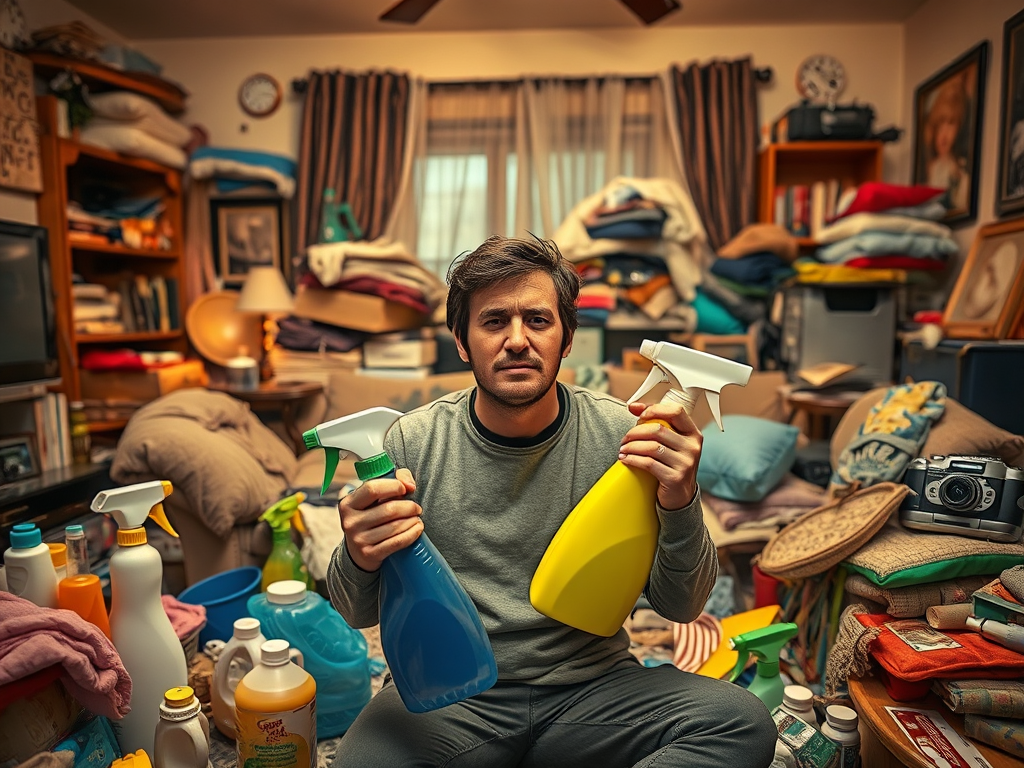
There’s probably no activity I hate more than cleaning.
A completely useless waste of time. We already spend our days at work, then sacrifice sleep and health to carve out a bit of free time—and filling that time with cleaning feels like the ultimate human helplessness.
And no, I don’t mean “if I don’t do it, someone else should.” It’s unfair to them too. Imagine your daily job being cleaning up other people’s mess. Doesn’t sound pleasant, does it?
I think schools should actually teach this. Well, they do a little, but only about the importance of cleanliness. Instead, they should tell kids: “Look, with your tiny brains you run around screaming, getting messy, but one day, all that playtime will be replaced by endless cleaning.” That would be honest. Instead of constantly saying, “your apron is dirty, clean it,” they could have taught us how to live with stained aprons. What if muddy shoes were never seen as abnormal?
I’ve written a lot about consumerism and how capitalism turns us into monsters, but honestly, one of the biggest consequences of greed, of wanting more, newer, better all the time, is this endless need for cleaning.
Das Kapital should be updated with a new verse: the more you own, the more you clean, and the less you actually live.
Capitalism’s answer is simple: earn more money and let someone else clean. That hypocrisy destroys me. Everyone claims to be against slavery—yet we pay for services and call it “just business.”
Why don’t you do the job then? I can’t stand people who think money entitles them to everything, who normalize making others do what they themselves despise. Once upon a time, slavery was “normal” too, and no one batted an eye.
And beyond slavery, there’s sexism and classism in it as well. For example, hardly anyone hires male cleaners at home—but when it comes to jobs requiring physical strength, suddenly it’s a “man’s job.” Convenient logic, right? People criticize the caste system in India, or brag about how the republic fought against tribal hierarchies—yet the moment they get power, they create their own tiny kingdoms.
Then there’s the environmental cost. When you pay someone else to clean, what are you really buying with that freed-up time? Consumption. More buying, more waste, more filth. Dirt isn’t just what’s in your house; it’s the garbage we dump on the planet.
And how did we get here? Sometimes I wonder what things were like before. No need to go back centuries—even 40 years ago the standards weren’t this insane. Today, everything you own demands cleaning: the house, the furniture, the car, the summer home, clothes, pets, even children. Everything must be washed, polished, sanitized. The time burden is insane.
Capitalism’s cycle is simple: work harder, earn little, spend it all, buy more, and sign up for a lifetime cleaning subscription. On top of that, the dream of “earning more” just leads to debt when it fails. And all for what? To buy shiny things and keep them spotless.
Even the simplest example: clothes. Washing isn’t enough. There’s ironing, care, storage. The more you value material goods, the more you become their slave.
The other day, I pulled a dusty book off the shelf. I inhaled its smell, and with every page I felt its lived history. But in today’s world? That dusty shelf would end up in the trash, or the book would be over-cleaned until it wore out, or replaced with sterile plastic pages that pollute even more. Dust was innocent. Dust killed nothing but time.
The Theft of Time
When taxes go up, people scream everywhere: “they’re stealing our money!” But since cleaning is framed as a choice, no one complains about the hours stolen from their lives by dusting and scrubbing.
Sometimes, while cleaning, I stumble across something. “Oh wow, I still have this?” When I first bought it, it felt so “important.” That alone proves that 99% of what we own is pointless junk.
Failure
In the capitalist world, dirt and mess are treated as personal failure—just like lives that don’t follow the standard script. Messy people actually earn my respect: they’re authentic, consistent in ethics, not pretending. And in a messy house, you’re not distracted by “should I buy this or that?”
Choice
It’s humanity’s choice. Of course, I’m not saying we should go back to the days where everyone died from infections at 30. But producing less filth, owning less, would be a sane choice for the planet. As I said, 99% of our possessions are unnecessary—things no one needed before, things that didn’t exist in our lives, things no one ever felt the need to clean. People didn’t even clean toilets back then; homes were just for sleeping and eating. Now? We’re cleaning rivers, seas, forests—all because of the trash produced by our “belongings.”
Alternative?
- Own less, clean less.
- Share more, produce less waste.
- Stop obsessing over impossible cleaning standards.
- Buy durable products instead of disposable ones.
- Avoid mass-produced junk.
- Accept dust, don’t lose your mind over it.
- Live in smaller spaces.
- And most importantly, drop the greed.
 bahadirhancicek
Leave a comment