
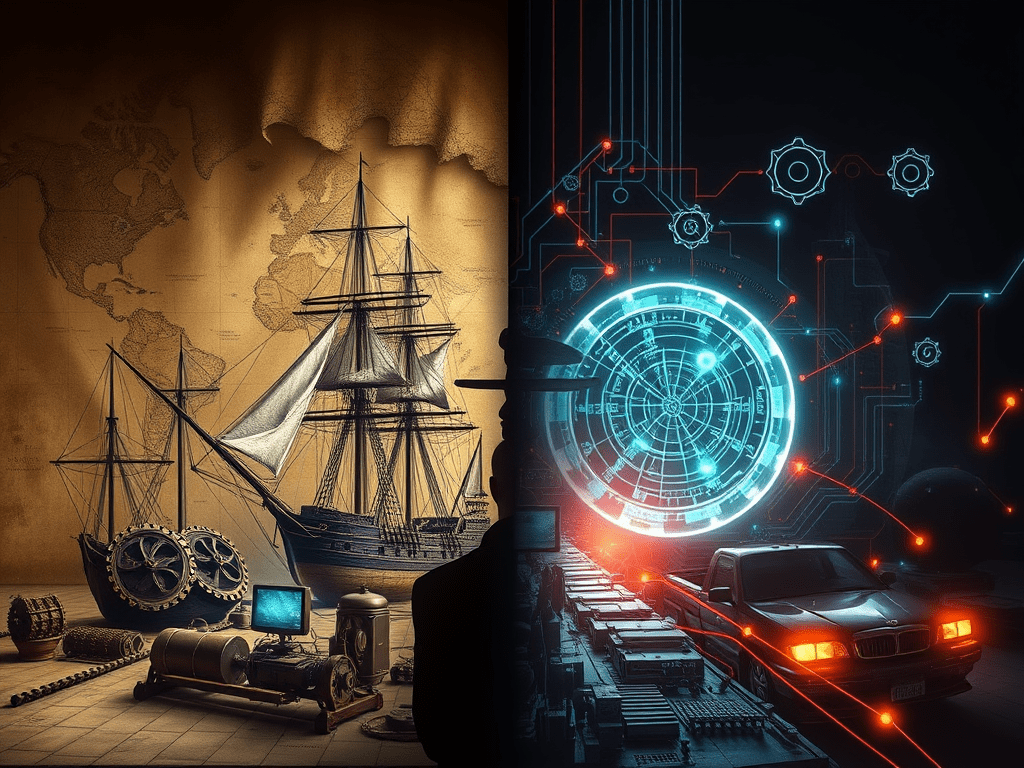
Humanity first tasted the benefits of a settled life with the advent of agricultural technologies. Then came technologies developed to protect against natural disasters. Over time, trade was discovered, and transportation technologies multiplied.
For centuries, history unfolded under the shadow of war. Curiosity, displays of power, and a certain linear way of thinking kept the cycle of conflict unbroken. As states grew, technology advanced, and distances became meaningless, new political systems and methods emerged. One of them was colonialism. The Ottoman Empire’s dominance over trade routes and the Church’s power in medieval Europe pushed others to search for alternatives. One major result of this search was the shift from spirituality—abstract belief—to materialism. Materialism allowed knowledge to transform into concrete tools, led above all by transportation and weaponry. Thus began a new era of geographical discoveries and powerful arms: colonialism.
Distances had now lost their meaning. Colonialism depended entirely on human power—on both the master and the enslaved. Precious metals, exotic foods, and every material good were extracted from lands taken by force, leaving behind chaos, diseases, and the Bible.
Photo by Noah Holm on Unsplash

Industrialization followed the technological activity driven by colonialism. By the early 18th century, machines were replacing humans. More demand required more production, which in turn demanded more interaction. Humanity had to speed up. The development of steam engines first transformed transportation, then production. Machines began to take the place of human labor. The world itself began to move faster. Everything had to be faster. This ushered in a new professional mindset—specialists were now needed.
Another consequence was globalization. States became more interconnected and had to make joint decisions. This changed both the aims and the conduct of war. Everyone began to settle into their place and seek new paths. Large central authorities gave way to nations. Empires faded into history. Because nations were defined by, and dependent on, the labor of their people, the old systems of master-slave and landlord-peasant were replaced by capitalism and democracy. The two world wars sealed this transformation. Even nations alone began to lose meaning, and global platforms were built—because everything was now interconnected.
Meanwhile, everything accelerated. The drive to possess made linear thinking seem like the “correct” way of thinking: more, better, bigger. In following this mindset, especially in the last 50 years, humanity has brought nature to the brink of destruction. We consumed selfishly and possessed greedily. Now, once again, we stand at the edge of change. The first change is environmental awareness and the unprecedented importance of thinking globally. The second is the transformation of democratic systems and the rising need for more participatory democracy. I’ll write more about this later.
Photo by Marvin Meyer on Unsplash

Now think about the flow of information throughout this development. Once upon a time, there were only sages and a handful of written books. You had to move physically to find knowledge. Trade and war increased the spread of information. Knowledge traveled from West to East, East to West. Beliefs gave way to materials. The development of materials led to printing technologies, which sped up the distribution of knowledge. As distribution accelerated, so did the results derived from knowledge. Literature, art, and science began to flourish. Industrialization increased access to knowledge further. Finally, digitalization eliminated the need for physical transmission. Today, we carry a “god of knowledge” in our pockets: ChatGPT.
This “god of knowledge” entered our lives at breakneck speed. Suddenly everyone around me was using premium accounts. From daily conversations to workplace roadblocks, even “what’s a healthy dinner tonight” questions—all were directed there. It’s one of the clearest signs we’re entering a new era. It feels as though we’re moving from “machines replacing human labor” to “machines making humans unnecessary.” While countries wrestle with refugee issues and citizens blame migrants for disappearing jobs, AI continues to reshape entire populations. Yet the real risk isn’t just this. Every job that disappears is accompanied by new jobs opening. In an age where everything is artificial, authenticity becomes even more valuable. Handcrafts and the human mind gain new importance. Likewise, critical thinking and systems thinking have never been so essential.
Technology, however, pushes us in the opposite direction. Take ChatGPT: it can write code—and does it well. But as the code grows complex, the quality of its output drops. This is precisely where the difference between an expert and a non-expert emerges. An expert reads every line, produces solutions, and maintains code integrity. A non-expert copies and pastes, explains the problem, and waits for ChatGPT to fix it. This behavior inevitably falls into the same loop: copy-paste, test. If it fails, repeat. All without ever understanding where the problem lies.
Photo by Dima Solomin on Unsplash

Then there’s the issue of wrong answers and fake references. Recently, I was searching for basic books on neuroscience. I asked ChatGPT. About 40% of the books it recommended didn’t actually exist. It made me wonder—what is ChatGPT for?
I remembered a note I’d taken from a book I was reading. Instinctively, I wanted to hit “Ctrl+F” to find it. Searching manually felt tedious. As I used ChatGPT in daily life, a similar laziness crept into Google searches too. Why search Google when you can ask GPT? Why sift through articles when you can ask GPT? Why go to a library—or even a doctor—when you can ask GPT?
AI easily takes over repetitive tasks, but now it’s slowly taking over human thinking too. I find myself in the same loop when dealing with topics where I’m not experienced. I’ve seen the same with my intern. They kept asking the same questions, but never grasped the underlying logic. When I asked about the reasoning, the answer once again came from ChatGPT—partially wrong, of course.
We can’t keep up with the speed anymore. To catch up, we rely on LLM tools. While they’re useful for organizing thoughts and sometimes offering new perspectives, they can also trap you in a box if you’re not an expert. The result is a society drifting away from reasoning, critical thinking, and focus—a society struggling to read even two lines or to comprehend what it reads. In other words, we are right in the middle of change.
In the dystopian scenario, we become a society with low IQ, losing even basic mental abilities, relying on robots to move and on AI to think and solve problems—ruled by machines and built by a small elite. The utopian scenario is the opposite: a society closer to nature, delegating governance and production to technology while devoting itself to creativity and communal life.
Such a society can only emerge by slowing down. I plan to write about slowing down too—to explore the “why” and “how.” Humans now have to think more. To avoid manipulation, to resist laziness, to find correct information, and to make knowledge meaningful again.
It’s a bit like the age of colonialism. Knowledge is increasing, but those who know how to use it will prevail. This time, though, we’re becoming slaves not to people but to technology. The only way out is to think more, to bring philosophy back into our lives, and to consider the consequences of our actions. Just as colonialism left behind chaos, diseases, and the Bible, we’re left with chaos, mental illness, and an AI that hijacks our minds. Maybe it’s already too late.
What do you think? Is it possible to preserve freedom and the essence of individuality without being swept away by the speed of technology?
 bahadirhancicek
Leave a comment