
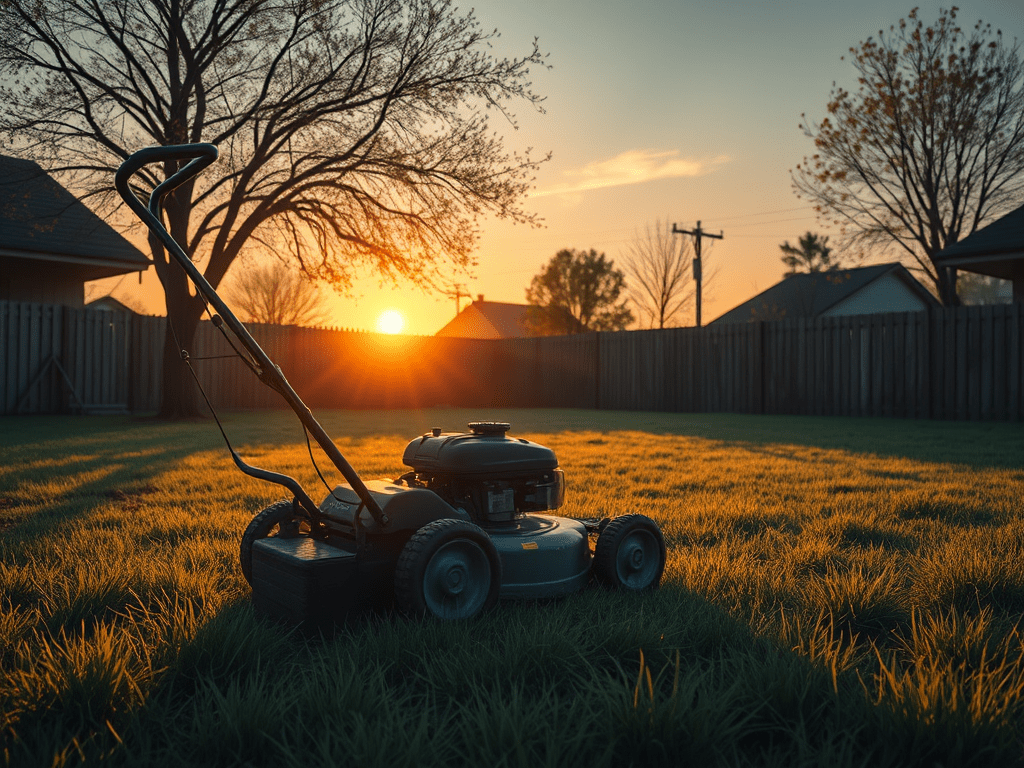
I shut down my computer, packed my bag, and, as usual, I was the last one to leave work. As I walked toward the car, something caught my eye: the lawn mower.
Quietly and patiently, it was mowing the grass, inch by inch. The office had closed, everyone was gone, but it was still working. Its wheels turned silently, sometimes getting stuck, trying to escape. It would rock back and forth, free itself from the trap, and continue its task with rhythmic spinning blades.
And that’s when I realized: it was the loneliest thing around.
Everything else had a companion.
Everything had a partner or a fellow. Buildings sat with their neighbors. Cars were lined up side by side, enjoying the weather like retired friends. The forest was full of trees, and those trees were accompanied by birds, insects, and people resting in their shade. They chatted with the wind and greeted the sun.
But the lawn mower? It had no one to talk to. No one hugged it, no one sat under its shade, no one asked, “How are you today?” It simply did its job in silence. And when it was done, it didn’t go to meet friends like I did. It returned to its charging socket. It wasn’t even like a robot vacuum cleaner at home—no warmth, no sense of belonging, no cat or dog playing beside it. It was outside. Quiet and alone. Just waiting for the next day.
This wasn’t the romantic loneliness of a tree in a field. A tree may appear alone, but it is visited. People sit under it, take photos with it, hang swings from its branches. A tree has history and life lived. Beneath it, countless stories are shared; it nourishes and shelters many living beings.
A tree is lonely, but it is filled with meaning.
The lawn mower, on the other hand, is invisible. No one remembers it. No one says “good morning.” It never hears, “You trimmed so well today.” It works, finishes, and is forgotten. When its life ends one day, a new one comes to replace it. No one remembers the previous one—not even in a “we used to have something like this” kind of way. Even if it’s not replaced, its absence isn’t noticed. The helplessness of invisible labor.
Some people are like that too, aren’t they? Some carry a loneliness like that of the tree in the field: modern loneliness within a crowd. And some are like the lawn mower: task-oriented, invisible, always working, always alone.
As I thought of all this, Kazım Koyuncu’s words echoed inside me:
“A void that no human can fill.”
That always reminds me of a deeply lonely tree. Even if it’s visited, its inner emptiness can’t be filled—a deep silence.
And then there’s this line:
“If I had the strength, I’d throw a stone
at the wall of loneliness.”
This, I feel, reflects the acceptance of the lawn mower perfectly.
Sartre once said:
“Man is condemned to be free.”
But the lawn mower doesn’t even have that. It has neither freedom nor choice. It simply performs what it’s programmed to do, and quietly returns to its place.
I can’t help but wonder what Camus or Hemingway would say in this situation. Camus would probably, in his familiar resignation, say:
“Keep cutting. There is no meaning, but there is rhythm.”
And I imagine Hemingway taking a deep breath, looking at the machine, and saying:
“It does its job. Doesn’t drink. Dies alone. That’s life…”
But can such loneliness really be lived with? Like in Kazım’s song—if you no longer have the strength to throw that stone, and you’re tired of mowing the same grass, the same way, every day… If you’re worn down from trying to do everything right and still being invisible—can a life like that be sustained? Can it go on when you’re stuck in the same loop, sometimes frozen, your blades dulling, and your unspoken thoughts stuck in your throat?
If I had to choose between the two, I would rather be a tree than a machine. Lonely, yes, but comforting with its shade. A tree that supports those who lean on it, becomes a playground for birds and climbing children, listens without judgment. A tree that gives life within its solitude. A tree full of life.
Loneliness sometimes begins with a task, sometimes with silence. And it always leads back to the same place: returning to yourself.
There’s nothing wrong with returning to yourself—but when that inwardness turns into the mechanical withdrawal of a lawn mower, maybe it’s time to stop the blades, take a deep breath, and lift your head.
Maybe it’s my preference for trees…
Whenever I feel tired, when the emptiness inside starts to weigh heavily, and I’m afraid of slowing down—I find a tree.
A tree I can lean on, where I can rest against its trunk and read a book, where I can think quietly… I listen to birdsong beneath it, watch the dance of its leaves in the wind, and drift into dreams.
When I touch its bark, I feel the texture carved by time, and I find peace in the patterns time has etched into it.
Its ability to be so social without moving—offering shade to passersby, a home for birds, a playground for children; witnessing love, pain, friendships, and serenity—gives me a strange sense of safety. The tree’s calmness, alongside its versatility, is a source of inspiration.
The way it becomes more beautiful as it ages, more respected; how every wrinkle in its skin holds an experience, and how it exists without rushing anywhere—reminds me that there are other ways to live. That sometimes… we need to slow down.
 bahadirhancicek
Leave a comment