
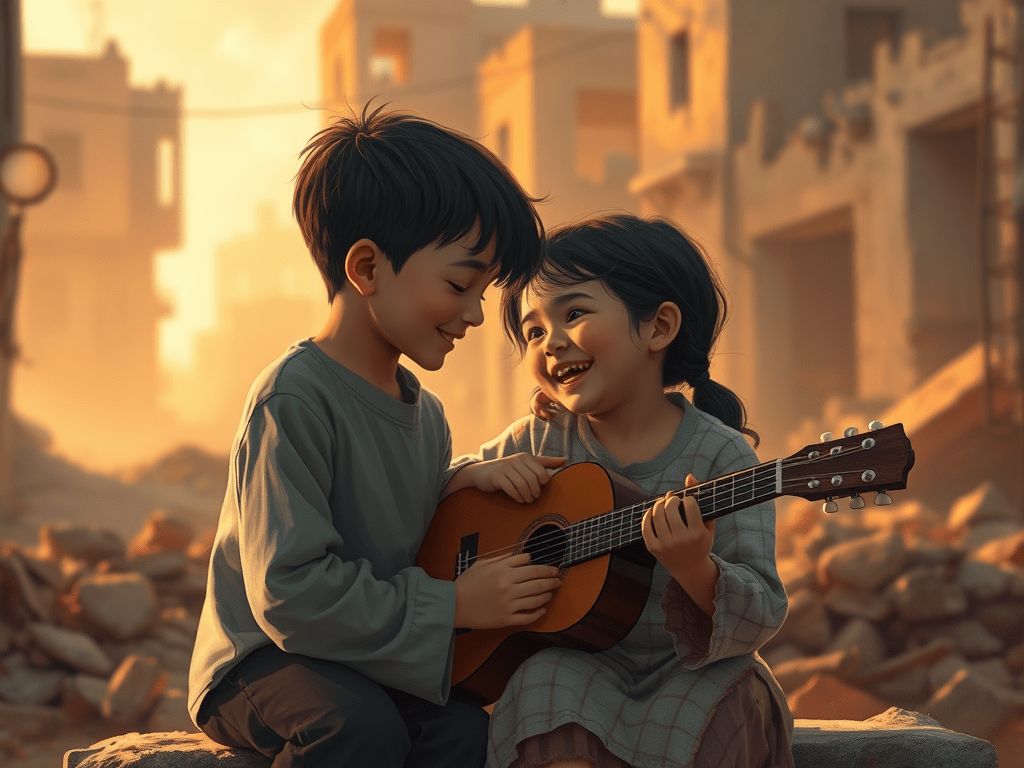
Yesterday I watched an anime movie: Grave of the Fireflies.
It was incredibly touching and profoundly sad. Instead of those ridiculous Hollywood hero movies, films like this should be shown to people who think war is just a game. It definitely tops my list of anti-war films.
In short, the movie tells the story of two siblings who lose their home and loved ones due to the bombing of Japan during World War II. The older brother is left alone with his younger sister. They first move in with their aunt, and later leave to try to survive on their own.
Naturally, as always, my mind drifted to completely different thoughts while watching the movie—this time, to the subject of love.
While staying with their aunt, she first seizes the remaining belongings of their mother. Then, she expects an enormous amount of gratitude. In one scene, while the siblings are playing the piano and singing together, trying to momentarily forget the sorrow of war, the aunt says, “My children are serving this country (as soldiers, volunteers), and you’re here singing and having fun.” That was the scene that truly triggered my thoughts.
We all know people like this. People who say “Don’t laugh,” “Don’t talk loudly,” who can’t stand your joy, who say “Is this the time for this?” People who say, “I’m already having a bad day, I don’t need to deal with you too,” who sulk and criticize as if to ruin your day. If you don’t know such people, you’re lucky—but they surely exist. In fact, we even see such joyless people on a national scale. “Would you throw a wedding at a funeral house?”
No, that wouldn’t be appropriate. But what if every day is a funeral?
I can’t understand how people can be so distant from joy, happiness, and love. Why does someone else’s happiness disturb them?
a) Because they haven’t managed to be happy themselves
b) Because they can’t reclaim the years of their life spent in misery
I’m not sure which is the correct answer. Maybe both. Maybe even more. But no one should stay this far away from joy, pleasure, and love.
Sometimes we even see it in the news: couples holding hands being attacked, or couples kissing on the subway being harassed. How can this be? Why?
One thing that struck me in the film was how purely love was portrayed. The bond between the siblings was depicted beautifully. Why is such a simple form of love so difficult?
I ask “why is it difficult?” because we forget the meaning of love. Social expectations, boundaries, and traditions outweigh even the simplest of emotions—love. We forget that love is a simple emotion. We forget how powerful the bond of love is.
When that bond is between siblings, we perceive it one way; when it’s between partners, we perceive it differently. But at the core, it’s the same. The only difference is that in one, sexual impulses and desires are involved, and in the other, they’re not.
Take the movie Call Me by Your Name, for example—it portrayed a homosexual relationship. Again, it was portrayed quite simply. It conveyed how normal the character’s feelings of love were—and they are. If someone feels attraction, desire, and emotional connection, what can stand in their way?
Yet we’ve become so alienated from this pure form of love that some go so far as to replace love at the center with hatred. Tradition, society, and social pressure turn into hatred. Tolerance doesn’t even exist—there’s zero tolerance. I think the root cause of this is lovelessness within oneself. Perhaps some people can’t even express the love they feel toward the opposite sex, so they can’t bear to see someone of the same sex feeling joyful love. Or perhaps they can’t be brave about their own disinterest in the opposite sex. They’re afraid of social codes, and that fear manifests as hate.
And so, love between young people, love between same-sex couples, love from children—everything becomes offensive.
Even in our own relationships, we might experience this suppression. We place traditions before love. Things like marriage and having a family become goals. We ignore the part about love and end up as unhappy couples, unhappy families. Because what matters to us is the “product.” And then we say, “Divorce has become so common,” “Society is falling apart,” “These are all Big Brother’s plans.” Yet while saying this, they’re unaware of the love they pour into politics, football teams, or other nonsensical things.
Or we witness the monsters that lovelessness creates: people being stabbed, found dead, abused…
As if all this wasn’t enough, we judge as well. “They look great together,” “They don’t match at all,” “How can she be with him?” “He’s too old,” “She’s too young,” “His religion is this,” “She doesn’t even speak the language,” “He’s from there? You can’t trust people from there,” “They don’t have kids?” “They don’t want kids?!” … and endless other prejudiced comments. Yet all of this only concerns the person who is the subject of love. Why is that so hard to accept?
A friend’s father once said:
“Going to a psychologist is trendy now. There were no psychologists back then!”
And that’s exactly the problem. Because people didn’t go “back then,” or because modern psychology hadn’t developed, there is now huge demand for psychologists.
The same applies to love. It’s because generations grew up without love that the world is so far from it now. You might say: “How can there be love in the middle of so many wars?”
When I first came to Europe, I thought love and tolerance were signs of development. Then I realized—they’re not. Even in extremely poor countries, in places where people have lost so much they can’t even dream anymore, there are people full of love—people who look at life with love. Maybe lovelessness is something unique to our own culture.
 bahadirhancicek
Leave a comment