Introduction: Is Democracy Still the Least Bad Option?
In one episode of Battlestar Galactica — if memory serves — a character answers the question, “Why democracy?”
Their reply: “Because it’s the most tolerable among terrible systems.”
In another scene, from Horace & Pete, a heated argument between a Republican and a Democrat is pierced by a simple, disarming question:
“What kind of life do you want — without saying ‘them’? What do you want for yourself and this country?”
The answer, it turns out, is almost always the same: safety, dignity, meaning.
That memory haunts me now, each time I scroll through social media or drift through headlines.
So I ask again: is democracy still tolerable? Or is our patience wearing thin?
The Streets Speak: Crowds That Refuse to Bow
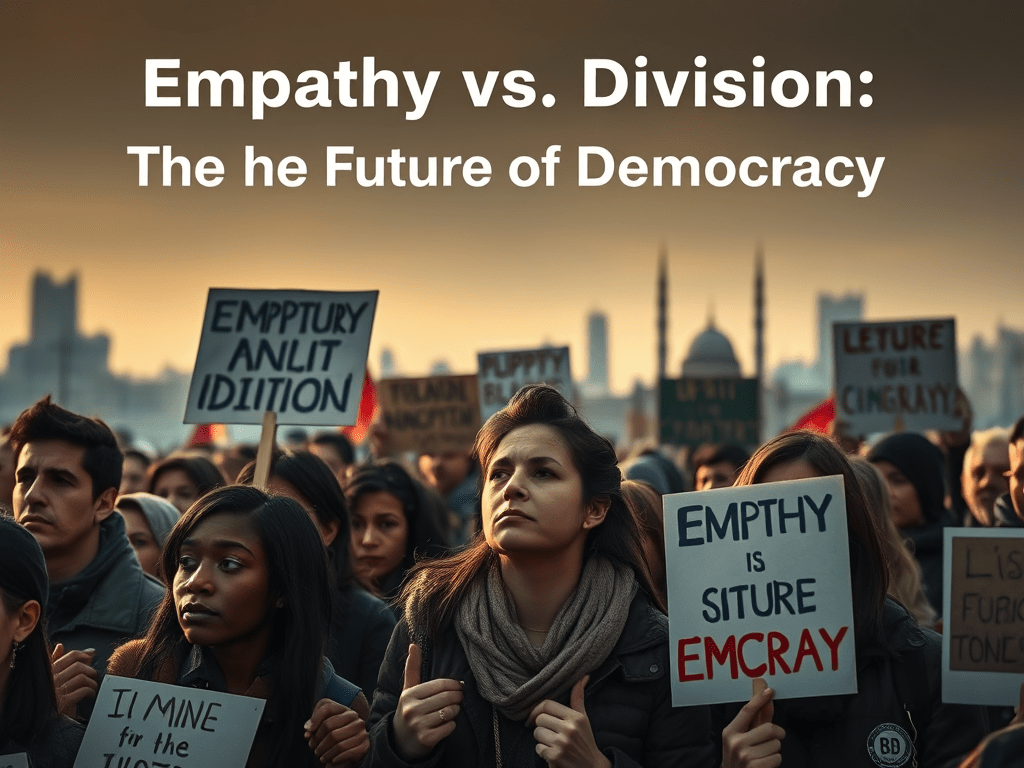
From Washington to Bucharest, from Istanbul to Tel Aviv, citizens have spilled into the streets again and again.
They protest not for spectacle but for survival — against creeping autocracy, for the promise of freedom.
Yet every time, the same cynical echo follows:
“Is this a coup against the elected?”
It’s a loop.
Education falters. Freedom is misunderstood. Propaganda churns.
And so democracy — once a tool of the people — becomes a shield for those who wish to dismantle it.
Those who challenge power are branded extremists, while the true extremists pose as saviors.
The Digital Flame: How Social Media Fuels the Divide
The media once filtered. Social media amplifies.
Outrage travels fastest; lies leap further than facts. There are no editors — only algorithms.
Clicks, not truth, drive the machine.
Add filter bubbles, and suddenly, nuance vanishes.
Refugees. Immigrants. Gaza. Tehran.
Even football becomes a battleground: Galatasaray vs. Fenerbahçe.
Choose a side. Or be cast aside.
Loyalty Rituals: Taking Sides Isn’t Enough Anymore
Today, it’s not just about where you stand.
It’s about who you condemn to prove your loyalty.
In the West, say “Israel is aggressive” — you’re a threat.
In Muslim countries, say “Iran targets civilians” — you’re a traitor.
Even saying “Let children live” invites fury.
Empathy has become a liability.
And blaming others? A cheap escape from the burden of thinking.
Empathy in Crisis: Numbers Don’t Cry
We no longer flinch at death counts.
Unless the number is massive, it barely registers.
And when the suffering is invisible — behind borders, beneath skin tones — we turn away.
It’s easier to blame the immigrant, the outsider, the “other,”
Than to confront our own failures.
Thought or Template? The Subtle Art of Manipulation
There’s a quieter force at play — identity, manipulated at birth.
Are we who we are by choice, or by chance?
Is a Muslim devout — or simply born in a Muslim land?
Is a racist hateful — or shaped by media that thrives on division?
We talk of freedom of thought,
but rarely ask: have we been taught how to think freely?
Today’s schools and screens don’t nurture thought.
They hand out pre-made opinions like uniforms — one-size-fits-all.
And Yet, I Still Dream
“I just want to live decently.”
To feel safe. To create. To live a life not rented to corporations.
A world where clothes, skin, and body aren’t causes for judgment.
A clean environment.
Nature within reach.
Food, shelter, water — not commodities, but rights.
Let those who want luxury strive for it — but not just to survive.
Let belief be private. Politics be personal. Let origins not matter.
Borders should not be cages.
Languages and cultures must thrive, not dissolve into sameness.
Stop classifying people.
Let every soul rise to its potential.
Who would oppose this?
If we each lived freely, no one would feel threatened.
Where Are We Going?
The world stands on a knife’s edge.
One spark — another Franz Ferdinand — and the talk of global war would erupt overnight.
The more we grieve lives we never got to live,
the more hatred finds room to grow.
And yet the question remains simple:
“What kind of life do you want?”
In the answers, we’re not so different after all.
Last Words: Can Democracy Be Saved?
Maybe.
But only if we first relearn how to think freely —
and then, how to see one another not as enemies, but as human beings.
Otherwise, we will keep tolerating the next name on the list
of terrible systems.
 bahadirhancicek
Leave a comment