Since my cousin went off to military service, he’s been repeating a phrase that struck me deeply:
“Has your freedom ever been taken from you?”
For some reason, I really loved this question.
Actually, I had been thinking about it for a long time—since reading The Captivity of Will, maybe for 6 or 7 years now. Are we truly free? How much of our decisions are our own? Is the way we live truly our choice, or are we trapped within the boundaries society has drawn? Are we simply a link in a repetitive, narrow chain? What happens if we step outside the norm—what happens, how does it happen, and how much do we care about society’s reaction or the judgment of those closest to us?
These questions take us all the way to a fate that feels helpless and imprisoning. But when I heard my cousin’s question, it hit me. I had so many questions—but this was the core one, the root question, and now it won’t leave my mind.
I can’t say that my freedom has ever been directly taken from me. But the more I reflect on this question, the more I see—across different places and times—how much freedom is actually limited. One place where this became very clear to me was Twitter.
From the beginning, I could never get used to Twitter. I opened an account when it first came out but closed it within a week, and stayed off the platform for years. But after a long break, curiosity about current events, a few writers I admire, and some popular profiles drew me back—and I opened a new account.
I’m not super active, but for the past few months I’ve kept a mostly idle profile.
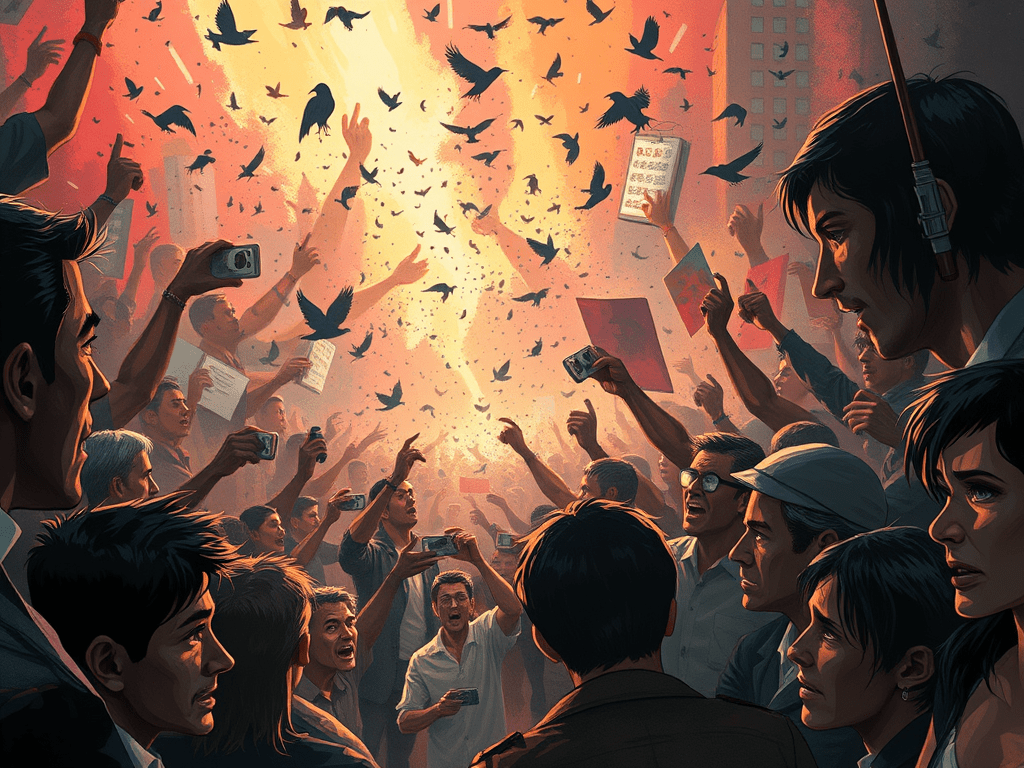
Yet every time I log in, what I see unsettles me. I feel like I’m in the middle of a massive fight—a battlefield. It’s as if I’m inside a fight scene from Kill Bill, the lobby shootout in The Matrix, or the iconic Scarface moment: “Say hello to my little friend.” I feel like a cook from Pearl Harbor, manning an AA gun and wanting to shoot wildly into the chaos.
Or, more innocently, it feels like being in a bar where the noise is so loud you can’t even hear the person next to you. A global ego war. A platform where it seems like everyone dreaming of instant fame has gathered. Everyone’s trying to write two sentences and become famous—or satisfy their ego.
As for actual information—it would be an insult to call it a trash heap; it’s more like the Everest of trash. A sea of false information and madness.
It’s filled with people so ignorant that if the entire populations of China and India were illiterate, you still wouldn’t find this much ignorance. These people believe anything they see or hear, interpreted through their own narrow values. I’m not even talking about the usual traits of the ignorant—denial, lack of empathy, blame-shifting, arrogance—but even smart people seem to become fools on this platform.
I’m torn between crying for the masses who cling to lies, or for the “intelligent” users who believe they can calmly explain the truth to those who would rather burn them at the stake in the name of “freedom of speech” or “respect.”
And then there are the hashtags. In Turkey, they’re almost all political. Under each hashtag, there’s a single dominant voice; anyone else gets instantly attacked, branded a traitor, terrorist, or disgrace. I’ve even seen people lump every opposing view into a single curse word in a fit of conceptual chaos.
And then there are the hopelessly naïve souls trying to share their views with the crowd… Or when none of that is happening, you find people fighting under dumb celebrity gossip or sports news, cheap emotional clickbait, or empty calls for “awareness” and “empathy”—the ugliest forms of even the best intentions.
In short, Twitter has become a place where ego, misinformation, ignorance, arrogance, hatred, and blind admiration are on full display in their ugliest forms.
Maybe it was always like this.
Maybe a platform originally meant as an SMS alternative simply ran off the rails (though its $2.1 billion annual revenue surely doesn’t care). Or maybe it’s become a space where off-the-rails people gather to chatter like birds—the logo is fitting, after all—a kind of digital coffeehouse.
Either way, if the digital world had an atomic bomb that could erase profiles and leave a lasting impact, I would happily drop it on Twitter. That’s about how much patience I have left for it.
Coming back to the core question: “Has our freedom ever been taken from us?”
I see Twitter as a place where minds are enslaved by 140-character limits. A community imprisoned by brevity. A platform where users fight under the shadows of celebrities and elites, disconnected from reality, living within their own distorted truths—just like Plato’s Cave.
Except here, the so-called “freedom of thought” doesn’t remind people of the value of freedom; it empties freedom of meaning.
Plato’s Cave
Some people are chained inside a dark cave from birth, facing the wall, unable to turn their heads. All they see are the shadows on the wall—shadows of people, animals, and objects passing in front of the cave’s entrance.
Their knowledge of the world is entirely based on these shadows. One person eventually breaks free and escapes the cave. When they see the true sources of the shadows, they can hardly believe it. It’s difficult and painful to leave old habits and illusions behind. Even when they return to the cave and try to explain the truth, the others will reject them—unwilling to believe that reality exists beyond the shadows they’ve always known.
 bahadirhancicek
Leave a comment