
Plato argued that the result of excessive freedom brought by democracy is also excessive slavery.
In such a system, where everyone has a say, the poor begin to seek justice against the rich and see them as enemies. Over time, when disagreements reach a point of no return, the majority—the poor—choose someone to lead them.
This person carries the seeds of tyranny. A tyrant who wants to maintain power for a long time and solidify his position first presents himself as a friend of the people. In the beginning, he smiles, offers hope to his followers and the public, soothes debtors, and distributes land to his supporters. Despite all this, the tyrant’s ego—born of tyranny—is so strong that he never wishes to relinquish power and keeps the people under his command. The easiest way to do this is to drag the people into war and burden them with taxes. This way, the people become impoverished and dependent on the ruler, unable to lift their heads to think. Those who oppose these actions, whether friend or foe, are punished, and it is made to seem that these punishments are lawful and serve to uphold social justice. A tyrannical soul knows no justice. It is a person who chases after needs and tries to satisfy passions.
Such a person is considered crude and ignorant, fears those who are superior and virtuous, and cannot form true friendships with them. Likewise, they cannot be friends with those far below them because they despise them. They only associate with those who are similarly crude, ignorant, obedient to their command, and useful to their interests—though this is not a true friendship but a relationship of convenience. Therefore, the tyrant trusts no one. He lives a life filled with hatred, is hated by others, sets traps, fears traps set against him, and fears internal enemies even more than external ones.
To secure his position, he hires mercenary guards. To prevent betrayal by these men, he must keep them well-fed. A ruler who leaves no true friends around him is forced to regard his mercenaries as friends and to trust them. Thus, the ability to remain in power becomes directly tied to financial means. Aware of this, the ruler funds all his expenses from the state’s sacred treasures and through heavy taxation of the people.
He is believed to be happy but is not. He is unhappy and lonely. Consumed by fear of losing power and distrust, he starts eliminating everyone, beginning with the most distant. Driven by such fear and ego, he ultimately spares not even those closest to him. In the end, he brings ruin upon both himself and the state. According to Plato, everything that is born must eventually decay…
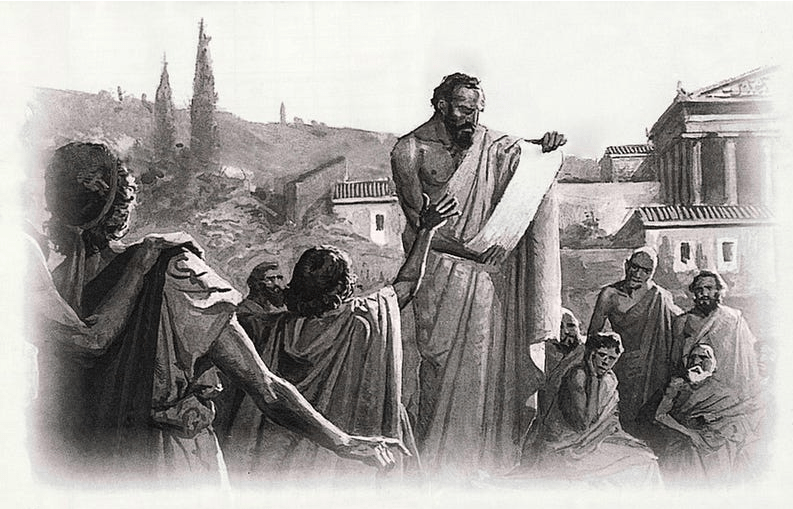
Plato, Republic
Yılmaz, Z. (2010). Plato’s Critique of Tyranny. Atatürk University
 bahadirhancicek
Leave a comment